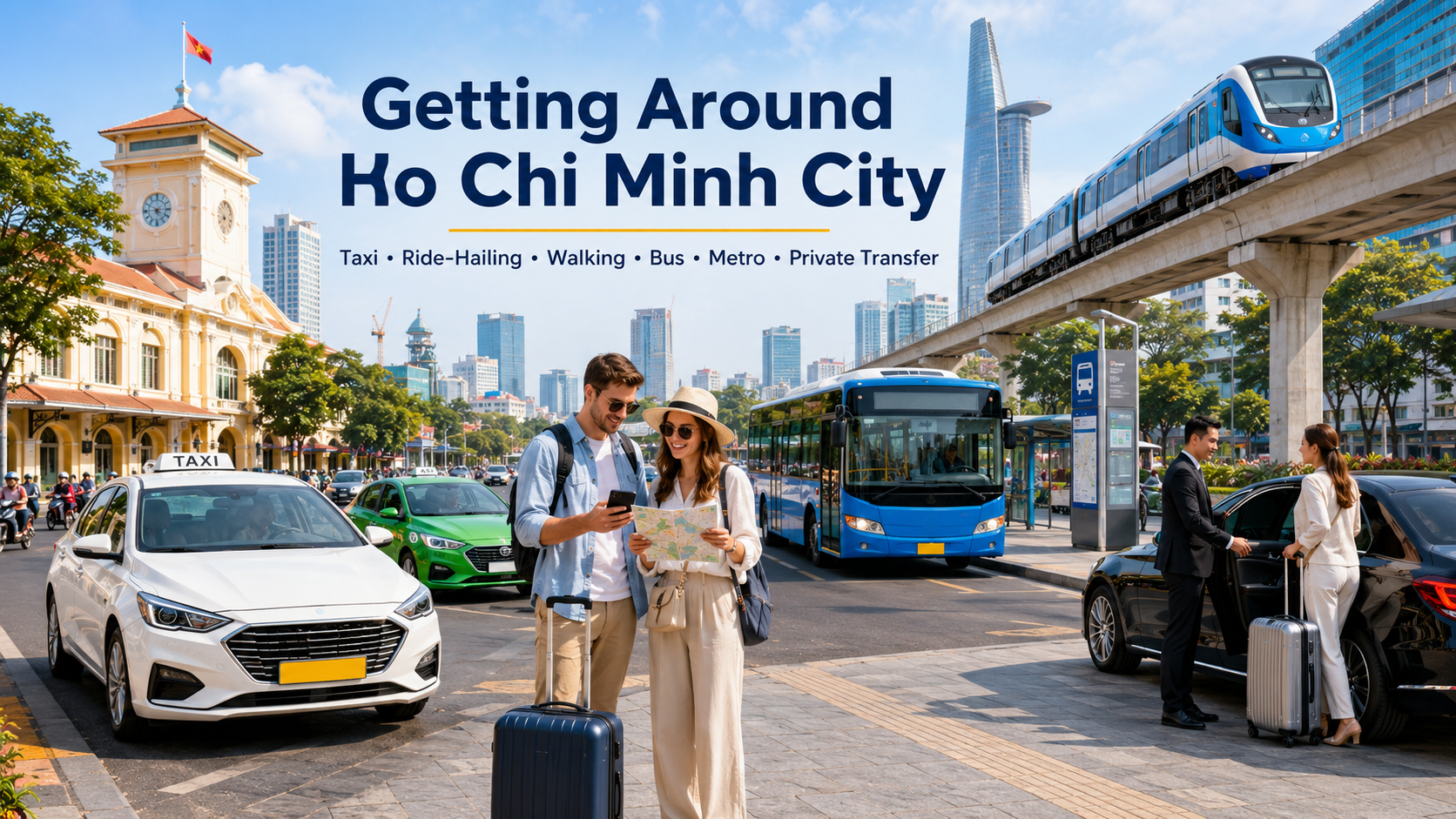
Hello, I’m Fito Thinh again. If this is your first time in Ho Chi Minh City, the traffic may look like a moving river of motorbikes. Please don’t panic. After a short time, you will understand the rhythm. The city is busy, but getting around becomes much easier when you know when to walk, when to book a car, when to use Grab, and when a private transfer saves your energy.
This guide gives you a simple local view of transportation in Ho Chi Minh City, especially for international visitors.
Mục lục tóm tắt
What Is The Best Way To Get Around Ho Chi Minh City?
The best way to get around Ho Chi Minh City is to combine Grab, taxis, walking, buses, the metro, and private transfers based on distance, weather, luggage, and travel purpose.
There is no single perfect option for every trip. Walking works well for short central routes. Grab is convenient for daily movement. Taxis are useful when available nearby. Buses and the metro can help budget travelers. Private transfers are best for airport arrival, family travel, business trips, and day tours.
Your transport choice should match your situation, not only the lowest price.
Using Grab In Ho Chi Minh City
Grab is one of the easiest transport options for first-time visitors in Ho Chi Minh City.
The app shows the driver, vehicle plate number, estimated price, route, and pick-up location. This makes it easier than negotiating directly on the street, especially when you do not speak Vietnamese.
GrabCar is better when you have luggage, travel with family, or move during the rain. GrabBike is faster for solo travelers, but it may feel intense if you are not used to motorbike traffic.
Before getting in, check 3 things: the license plate, driver’s name, and destination. Stand at a safe pick-up point where the car or motorbike can stop without blocking traffic.
Taking Taxis In Ho Chi Minh City
Taxis are practical when you choose reputable companies and confirm the route clearly.
You can find taxis near hotels, malls, airports, tourist areas, and major streets. Taxis are useful when your phone battery is low, when app pick-up points are confusing, or when a taxi is already waiting nearby.
Use metered taxis from trusted brands or ask your hotel, host, or local guide to help call one. Avoid accepting unclear taxi offers from random people at tourist spots.
Before the ride starts, show the destination address on your phone. It is helpful to save your address in both English and Vietnamese.
Walking Around Central Ho Chi Minh City
Walking is useful in central Ho Chi Minh City, especially around Bến Thành, Nguyễn Huệ, Đồng Khởi, the Central Post Office area, and riverside streets.
Walking gives you the best chance to notice small cafés, local food stalls, shops, temples, old buildings, and everyday street life. It is also the best way to enjoy short routes that would take longer by car during traffic.
However, sidewalks can be uneven, busy, or partly occupied by parked motorbikes. Wear comfortable shoes, keep your phone away from the traffic side, and carry water during hot hours.
When crossing the street, walk slowly and steadily. Do not run, stop suddenly, or make unpredictable movements. The traffic looks chaotic, but motorbike riders usually adjust when pedestrians move calmly.
Taking The Bus In Ho Chi Minh City
Buses are a budget-friendly option for travelers who have time, patience, and a clear route plan.
Ho Chi Minh City buses connect many neighborhoods, transport hubs, and local areas. They are not always the easiest choice for first-time visitors with luggage, but they can be useful for longer stays, students, budget travelers, and people who enjoy local public transport.
Use a route-planning app before taking the bus. Check the bus number, nearest stop, direction, estimated time, and final stop. Keep small cash or check as available payment methods before boarding.
Buses are better during the daytime. At night or during heavy rain, ride-hailing cars or private transfers are usually easier.
What About The Metro?
The metro is useful when your route matches the current operating line.
Ho Chi Minh City Metro Line 1 connects Bến Thành with the eastern side of the city toward Suối Tiên. It can be helpful for visitors going to locations near its stations, especially when they want to avoid road traffic.
For many first-time tourists, the metro is not yet a complete replacement for cars, taxis, or walking because travel plans often include different central streets, restaurants, cafés, and hotels. Treat the metro as one useful option inside a mixed transport plan.
When Should You Use A Private Transfer?
A private transfer is best when comfort, timing, luggage, or safety matters more than saving a small amount of money.
Private transfers are especially useful for:
- Airport arrival and departure
- Late-night check-in
- Family travel with children
- Business meetings
- Day trips to Cu Chi, Mekong Delta, or Can Gio
- Travelers with large luggage
- Guests who prefer direct local support
A private transfer gives you a fixed arrangement, clearer pick-up, and less stress after a long flight. This is helpful at Tan Son Nhat International Airport, where first-time visitors may feel confused by crowds, signs, luggage, SIM cards, and transport choices.
Airport Arrival Transport Tips
Airport arrival is the moment when good transport planning matters most.
After immigration and luggage collection, you need to move from the arrival hall to your accommodation. You can use Grab, airport taxis, hotel pick-up, or a pre-arranged private transfer.
Prepare your accommodation address before landing. Keep it saved offline. If you use Grab, follow the correct pick-up instructions in the app and check the plate number before entering the car. If you use a private driver, confirm the name, sign, meeting point, and phone contact before your flight.
For first-time visitors, a pre-arranged airport transfer often gives the smoothest start.
How To Choose Transport By Situation
The right transport depends on the trip you are taking.
| Situation | Best Option | Why It Works |
|---|---|---|
| Short central route | Walking | Easy, flexible, and good for sightseeing |
| Daily city movement | Grab or taxi | Convenient and clear pricing |
| Airport arrival | Private transfer or GrabCar | Better for luggage and first-time visitors |
| Budget travel | Bus or metro | Lower cost and local experience |
| Rainy weather | GrabCar or private transfer | More comfortable and dry |
| Day trips | Private car or guided tour | Better timing and route control |
This simple comparison helps you avoid using the wrong option at the wrong time.
Where To Stay For Easier Transportation
A central stay makes transport easier because you reduce long rides across the city.
First-time visitors should consider areas near Bến Thành Ward, Sài Gòn Ward, or Cầu Ông Lãnh Ward. International travelers may still understand this central zone as the former District 1 area. These locations help you reach food, cafés, attractions, nightlife, and pick-up points more easily.
Compass Stay in Cầu Ông Lãnh Ward can be a practical option for guests who want a serviced apartment with central access, a calmer atmosphere, and easier movement around the city. It works well for visitors who prefer privacy, a kitchenette, laundry convenience, and local support during their stay.
How Fito Thinh Can Help
Fito Thinh can help international visitors arrange transportation in Ho Chi Minh City based on arrival time, accommodation location, travel style, and budget.
Support can include airport pick-up, private car transfer, custom city routes, day trip transport, local guide arrangement, visa support, and accommodation guidance. The goal is simple: help you move around safely and avoid confusion during your first days in the city.
Link book via OTA App: Booking, Agoda, and Airbnb
Book directly with us:
- Hotline Compass Stay: +8470 404 8184 (Hotline, Zalo, Whatsapp)
- Hotline Fito Thinh: +84 905 835 538 (Hotline, Zalo, Whatsapp)
- Apply directly via https://www.vietnam-visa.in/apply-vietnam-visa/
- Book a flight to Vietnam via Agoda
- Booking Hotel Việt Nam
Getting around Ho Chi Minh City is easy when you match the transport method to the moment.
Use walking for short central routes, Grab for daily movement, taxis when convenient, buses and metro for budget or local travel, and private transfers when comfort and timing matter. The city may feel busy at first, but it becomes manageable when your transport plan is clear.
With the right habits, you can spend less time worrying about traffic and more time enjoying coffee, food, culture, and the energy of Ho Chi Minh City.