Current travel notice: Tràng An announced a suspension of visits on 9 November 2026 because of heavy rain and strong winds. Reopening depends on conditions and a further announcement. Check the official notice or ask your accommodation to call 1900 9251 before traveling. This itinerary assumes normal operations; it is not confirmation that boats are running.
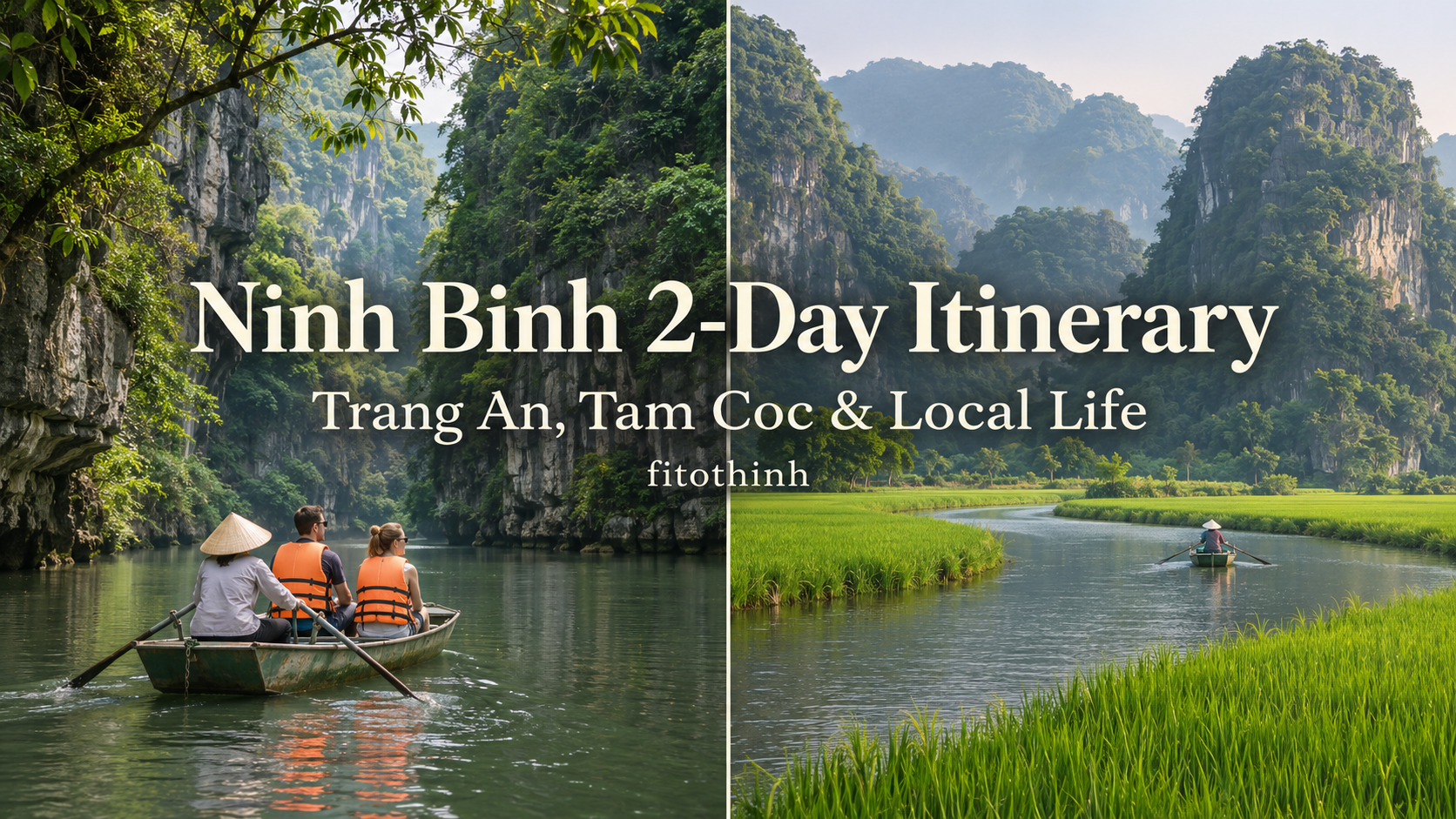
Ninh Bình deserves more than the hours left between a Hanoi hotel pickup and the return bus. This Ninh Binh 2 day itinerary gives the landscape a little breathing room: Tràng An on the first day, Tam Cốc on the second, and an evening when you can stay beside the fields instead of watching them disappear through a window.
My recommendation is one countryside night, two boat rides on separate days, and enough flexibility to enjoy lunch without checking your watch between mouthfuls. Add Hang Múa when the weather and your knees agree. Reach Bích Động by bicycle if the roads feel comfortable. Leave room for a café that was never on your spreadsheet.
Starting from Hanoi still involves a travel morning. You will not automatically beat every tour bus to Tràng An. The clearer advantage comes after check-in: a quieter evening and a second morning already in Ninh Bình. That is what makes the extra night useful.
Mục lục tóm tắt
Is 2 Days Enough for Ninh Binh?
Yes. Two days and one night is a good first visit, provided you arrive early and keep optional stops optional. Tràng An, Tam Cốc, Hang Múa, Bích Động and short village rides can fit, with adjustments for queues and weather.
Choose two nights for a late arrival, young children, photography or a separate nature day. Give Cúc Phương a separate forest day; consider Vân Long or Thung Nham for a nature-focused alternative. Bái Đính deserves substantial time for visitors interested in Buddhist architecture. Replace another activity rather than adding everything.
Still deciding whether to stay? Read Ninh Binh from Hanoi: Day Trip or Overnight Stay? This guide starts with the next decision: how to use that night well.
Ninh Binh 2-Day Itinerary at a Glance
These are planning windows, not guaranteed operating times. Let a delayed boat push out an optional stop rather than lunch.
| Time | Day 1 | Day 2 |
|---|---|---|
| Early morning | Leave Hanoi around 06:30–07:00 | Hang Múa, after confirming opening time and weather |
| Morning | Arrival, luggage arrangements; Tràng An around 09:00–12:30 | Breakfast; Tam Cốc boat around 09:00–11:30, allowing longer if needed |
| Lunch | Local meal and rest | Lunch after the boat or Bích Động, depending on timing |
| Afternoon | Hoa Lư or check-in, rest and short countryside ride | Bích Động and a short village ride; collect luggage |
| Late afternoon/evening | Tam Cốc dinner and overnight stay | Leave around 15:00–16:30, or take a suitable onward train |
Trang An vs Tam Coc: Should You Do Both?
Both involve a rowboat and limestone scenery. Their differences make two rides worthwhile for travelers who enjoy being on the water.
| Feature | Tràng An | Tam Cốc |
|---|---|---|
| Landscape | Enclosed valleys and towering karsts | Open Ngô Đồng River and agricultural scenery |
| Caves | Different cave combinations by route | Three principal caves |
| Cultural stops | Temples and shrines, depending on route | River journey, with nearby heritage visits afterward |
| Time to reserve | Around three hours, sometimes longer | Around two hours, with a two-to-three-hour buffer |
| Rice views | Not the main reason to choose it | A major attraction when crops are in season |
| Best fit | Varied first introduction | Rice photography and a more open landscape |
For one ride, my default is Tràng An. Choose Tam Cốc instead when rice views matter most. Skip the second boat if long sitting, small children or a stronger interest in cycling makes it feel repetitive.
The UNESCO-listed Tràng An Landscape Complex, inscribed in 2014 for both cultural and natural value, includes Hoa Lư Ancient Capital, the Tràng An–Tam Cốc–Bích Động landscape and Hoa Lư Special-Use Forest. Archaeological evidence spans more than 30,000 years. Villages, farming and temples belong to this landscape too.
Getting From Hanoi to Ninh Binh
Vietnam Tourism describes approximately two hours by road or train. Allow longer door to door for collections, station access, luggage and the final transfer.
Pair the countryside stay with the Hanoi 3-day itinerary.
| Option | Who it suits | Practical trade-off |
|---|---|---|
| Train | Independent travelers who enjoy rail journeys | Ninh Bình Station requires an onward transfer to Tam Cốc or Tràng An |
| Limousine/minivan | Travelers wanting simpler tourist-area access | Confirm the exact pickup, drop-off and luggage allowance |
| Private car | Families, small groups and flexible departures | Compare the full vehicle price, including waiting and sightseeing |
| Large coach | Travelers prioritizing the fare | Terminal transfers can reduce the saving and consume time |
An advertised X.E Vietnam example is 230,000 VND for Hanoi Old Quarter–Tam Cốc or Tràng An. Its cheaper city services are different products. Confirm the fare per passenger and per direction before paying.
Vietnam Railways’ published timetable showed an early 06:00 Hanoi / 08:16 Ninh Bình service during research. Treat this as a planning example: select your actual date in the official railway system to confirm availability and fare. The Vietnam train travel guide explains the wider logistics.
Arrange luggage storage before sightseeing; morning storage does not mean early room access. A direct Tràng An drop-off only helps if your luggage has a secure, agreed place to stay.
Address note: the 2025 restructuring merged the former Ninh Bình, Hà Nam and Nam Định provinces into expanded Ninh Bình Province. Older district names may remain online. Share the property’s map pin; a changed administrative label does not mean the hotel moved.
Where to Stay
Tam Cốc is my default for this itinerary. Restaurants and evening options make the overnight easy, while Day 2 stays focused on nearby sights.
| Base | Main advantage | Check before booking |
|---|---|---|
| Tam Cốc area | Convenient meals, bikes and Day 2 logistics | Walking distance to dinner; noise near busy roads |
| Tràng An countryside | Quieter surroundings | Dinner availability and transport after dark |
| Ninh Bình urban area | Station access and city services | Extra transfers for countryside sightseeing |
A “homestay” may be locally owned guest accommodation rather than a room inside a family’s private home. Neither that label nor “hotel” guarantees atmosphere or quality.
Ask about heating in winter, air-conditioning in summer, private bathrooms, stairs or elevators, early breakfast, luggage storage and bicycle condition. For limited mobility, request photographs of the actual room entrance and bathroom.
Day 1: Hanoi to Trang An
Trang An Boat Ride
Leave Hanoi around 06:30–07:00 if using road transport. An arrival around 09:00 is a target, not a promise. Allow the morning and some of lunchtime for Tràng An, including tickets and boarding.
Reserve about three hours on the water, potentially longer for the chosen route. This is the main activity of Day 1. A slow boat does not need a fast afternoon to compensate.
For the earliest boats, arrive in Ninh Bình the previous evening. A same-morning transfer from Hanoi cannot guarantee a quiet wharf.
Choosing a Boat Route
Ninh Bình Tourism’s published route guide describes four routes. That does not mean all four operate every day.
Ask which routes are open, how long they take, and whether they emphasize caves or temple stops. Choose for your interests and comfort rather than following a permanent “Route 3 is best” rule.
Use the toilet before boarding. Bring water, sun protection and a rain layer when needed; winter wind can feel colder when you are sitting still. Ask about sharing arrangements rather than expecting a private boat at the standard ticket price.
Local Lunch
Allow roughly 12:30–14:00 for lunch and rest, shifting later if your boat returns late. Order a few shared dishes and try cơm cháy, the local crispy rice specialty. There is no need to climb a mountain immediately after eating.
Hoa Lu or a Slow Countryside Afternoon?
History enthusiasts can give Hoa Lư Ancient Capital around 60–90 minutes, plus transfers. Its setting helps explain why the capital developed here in the tenth and eleventh centuries. A knowledgeable guide adds more than another hurried photograph.
Otherwise, check in, rest and take a short ride near your accommodation. Choose one afternoon direction. Hoa Lư, extensive cycling and a sunset climb are competing plans.
Cycling and Local Life
Ask your host for a short loop using public, low-traffic lanes. Around Tam Cốc and Văn Lâm, let a café or a view from the roadside be enough of a destination.
Check brakes, saddle height and lights before leaving. Bring water, save your accommodation’s map pin and return before darkness if your bicycle is poorly equipped. A pretty lane can still carry motorbikes and farm vehicles.
Evening in Tam Coc
Have dinner, walk where lighting and traffic allow, then sleep early if you want a morning climb. A terrace and a drink can be the whole evening plan.
Hoa Lư Old Town is an optional outing for a busier, illuminated setting. It is distinct from Hoa Lư Ancient Capital and adds transport; countryside travelers can happily skip it.
Day 2: Hang Mua, Tam Coc and Bich Dong
Hang Mua Early Morning
Hang Múa involves roughly 500 steep steps. Budget around 60–90 minutes for the climb and viewpoint, plus transfers, adjusting to your pace.
Confirm the current opening time before arranging an early pickup. The operator’s older page lists seasonal early opening, but it also contains an outdated ticket price; it should not be treated as a freshly confirmed schedule.
Go when heat is manageable and visibility makes the effort worthwhile. Fog can hide the view, and wet steps change the decision. Wear shoes with grip, carry water and avoid exposed edges. Skip the climb if conditions or mobility make it unsuitable. Breakfast with a mountain view remains a perfectly respectable achievement.
Tam Coc Boat Ride
After breakfast, head to the Tam Cốc wharf. The traditional route follows the Ngô Đồng River through Hang Cả, Hang Hai and Hang Ba: the three caves behind the name Tam Cốc.
Plan around two hours, but protect a two-to-three-hour window including boarding and operational variations. Ask today’s expected return time before booking your next transfer.
Here, agricultural scenery opens beside the river. The contrast with Tràng An is strongest when the fields are growing or ripening. Foot rowing is a local working technique; enjoy observing it without asking your rower to perform for the camera.
Buy through the legitimate ticket counter and confirm exactly what your ticket includes. The newer Tam Cốc–Bích Động tariff should not be combined blindly with older separate boat-price formulas.
Bich Dong Pagoda
Allow about 45–60 minutes, excluding the ride there. Bích Động’s three levels rise into the mountainside, so this is another visit with stairs, not a fully accessible substitute for Hang Múa.
Keep to suitable lower areas if necessary, after checking access. Cover shoulders and knees, keep voices low, respect worshippers and follow posted footwear rules.
Is Bích Động free? Do not assume so from older blogs. It appears in the current combined sightseeing route. Ask whether your ticket covers your intended access, especially if visiting independently without a boat ride.
Cycling the Village Lanes
The Tam Cốc–Bích Động outing works well by bicycle when conditions suit. Ask locally for the quietest practical route and walk the bicycle through uncomfortable traffic sections.
Thái Vi Temple can be an optional stop on another short loop. Drop it if the boat runs late. Use taxis or an arranged car for farther transfers, particularly between Tràng An and Tam Cốc; you do not need a scooter.
Local Lunch
Eat before Bích Động if hungry after the boat. Otherwise, return for a relaxed Tam Cốc lunch. Leave time to retrieve luggage, change clothes and meet your driver without turning the final hour into a race.
Return to Hanoi or Continue South
A departure around 15:00–16:30 preserves useful afternoon time. Allow for traffic and station or airport access. Keep a substantial buffer before critical connections, especially an international flight.
If continuing south, check trains from Ninh Bình before automatically backtracking to Hanoi. Fit the stop into your two-week Vietnam itinerary. In a ten-day trip, an overnight stay needs time taken from elsewhere.
What to Eat in Ninh Binh
| Dish or meal | What to expect |
|---|---|
| Cơm cháy | Crispy rice crust, served as a snack or with accompaniments |
| Goat dishes | A regional specialty; ask about preparation |
| Dê tái chanh | Goat with citrus and herbs; request a fully cooked alternative if preferred |
| Tofu, greens and rice | Useful choices for a shared meal without goat |
| Breakfast noodles or bánh cuốn | Choose what your accommodation or nearby kitchen prepares that morning |
Vegetarian travelers should ask about fish sauce, broth and toppings, including on crispy rice. Tell the kitchen about allergies clearly. Enjoying Ninh Bình is not a goat-eating examination.
Best Time for This Itinerary
Golden-Rice Season
The famous Tam Cốc golden-rice window is generally late May to early June, according to Vietnam Tourism. Harvest timing varies. Ask for current field conditions before booking primarily for photography.
Spring can bring milder outings and greenery, while festival dates and weekends increase demand. Golden rice is not a reliable promise for February or autumn.
Summer
Expect heat and humidity, with possible storms. Put exposed activities early, protect lunch and rest time, and avoid a midday Hang Múa climb. A hat helps; it does not create air-conditioning.
Autumn
Cooler, clearer conditions can suit cycling and viewpoints. Still check the forecast: a seasonal recommendation does not override a heavy-rain warning.
Winter
Cool, drizzly weather can produce atmospheric scenery and chilly boat rides. Bring a warm layer and rain protection. Read Vietnam in January and Hanoi in winter when planning the northern portion of your trip.
Rainy-Day Adjustments
In light rain, ask whether boats are operating safely and shorten cycling. Skip slippery viewpoints. A longer lunch, covered café stop and suitable lower-level heritage visit may work if access is safe.
During strong wind, heavy rain or flooding, follow closures and transport advice. Do not simply switch boat operators to work around a regional warning. Move the outing to another day, remain at safe accommodation or postpone the excursion. The current Tràng An notice above takes priority over this timetable.
Family Version and Mobility Adjustments
For young children, choose one boat, skip Hang Múa and protect rest time. Day 1 can be Tràng An, lunch and accommodation time; Day 2 can be Bích Động’s suitable areas and a short countryside outing. Families comfortable with both rides can retain Tam Cốc and drop cycling.
Ask about correctly fitting child life jackets, low boat boarding, long sitting periods and toilet access. Use a car when cycling arrangements are unsuitable.
Apply the same questions to older travelers according to mobility, not age. Bích Động also has stairs. Solo travelers can use shared transport, but should confirm boat assignments and the full cost of any private service.
Relaxed One-Boat Alternative
Day 1: Tràng An, lunch, then optional Hoa Lư or rest.
Day 2: Hang Múa if suitable, breakfast, Bích Động and gentle cycling, with Thái Vi optional.
This gives more time on land. During golden-rice season, you can choose Tam Cốc as your only boat instead and rearrange the days accordingly.
Photography Version
Move Hang Múa to late afternoon on Day 1, replacing Hoa Lư and extended cycling. Keep lunch and rest after Tràng An.
On Day 2, take Tam Cốc as early as confirmed operations allow, then choose Bích Động or village lanes. Two nights work better if you also want an early Tràng An departure. Light, crops and weather remain variables, not inclusions in your ticket.
How Much Does 2 Days Cost?
Use these 2026 references for preliminary 2027 planning, then reprice your dates. Official attraction figures come from Ninh Bình Tourism’s tariff and the landscape management board.
| Item | Reference checked 9 November 2026 | What to confirm |
|---|---|---|
| Tràng An | 300,000 VND, over 1.3 m | Current tariff and route; scenic/boat ticket |
| Tam Cốc–Bích Động | 250,000 VND adult; 350,000 with electric transfer | Boat component, access and shuttle stops |
| Hang Múa | 150,000 VND, over 1 m | Current entry fee and hours |
| Hoa Lư Ancient Capital | 20,000 VND adult | Optional visit |
| Hanoi Old Quarter–Tam Cốc | X.E Vietnam advertises 230,000 VND | Direction, passenger fare, collection and luggage |
| Double room | Tam Coc Valley Eco Resort advertises from 1,400,000 VND/night | Dates, final taxes, cancellation and availability |
| Bicycle | That resort advertises complimentary guest bicycles | Availability, condition and permitted use |
| Meals and local taxis | Add separately | Menus and route-specific quotes |
The three main adult attraction references total 700,000 VND, or 800,000 VND with the electric-transfer option. Hoa Lư adds 20,000. For two adults, that is 1.4 million VND before transport, accommodation and meals; confirm Tam Cốc inclusions before treating it as the final total.
For illustration, two adults using the advertised 230,000 fare in both directions and a 1.4-million room would reach 3.72 million VND together, before meals, local transfers and extras. This is arithmetic using advertised examples, not a bookable package or guaranteed minimum.
Tràng An’s table lists 150,000 VND for children 1–1.3 m and person over 60; under 1 m is free. Tam Cốc lists 120,000/190,000 VND for children 1–1.3 m without/with electric transfer. Confirm eligibility and boundary measurements at purchase.
Should You Book a Tour?
Independent travel suits flexible meals and cycling. A private tour can simplify family transfers and add historical context. A group package reduces planning, but check actual boat time, hotel location, shopping stops and included tickets. Compare complete costs rather than headline prices.
Responsible Travel and Local Etiquette
Wear your life jacket, follow seating instructions and duck when the rower directs you. Do not stand suddenly, demand risky photo maneuvers, touch cave formations or play loud music. Tips are voluntary, not an invented compulsory ticket surcharge.
Rice fields are workplaces. Stay on public paths, leave crops and tools untouched, and ask before close portraits. Do not enter homes uninvited. A friendly conversation is welcome when it happens naturally; nobody owes visitors a performance of village life.
Carry rubbish out, refill water where suitable, avoid feeding wildlife and obtain required permission before drone use. UNESCO identifies tourism pressure as a management concern here. Thoughtful behavior protects the landscape people come to enjoy.
Common Ninh Binh Itinerary Mistakes
- Treating two days as permission to see everything.
- Putting both boat rides on one day.
- Climbing Hang Múa in summer’s midday heat.
- Expecting golden rice in every month.
- Booking an urban base without considering transfers.
- Taking large suitcases to the wharf.
- Renting a scooter without suitable experience, licensing and insurance.
- Entering fields for photographs.
- Budgeting from old ticket structures.
- Forgetting modest clothing for pagodas.
- Adding Bái Đính without removing another substantial visit.
- Leaving so early on Day 2 that the extra night achieves little.
Fito’s Local Tips
- Give each boat its own day; your back may thank you.
- Choose Tam Cốc for this route’s simplest overnight logistics.
- Arrive the previous night if the earliest Tràng An boat matters.
- Climb when the weather is kind, not because the alarm rang.
- Ask about actual rice conditions; crops ignore booking confirmations.
- Keep one short bicycle outing without a compulsory destination.
- Try cơm cháy and order the rest according to your tastes.
- Keep the afternoon after Tràng An light.
- Request permission before close portraits.
- Spend the extra night buying time, not collecting tickets.
FAQ
Is two days enough for Ninh Binh?
Yes, with an early arrival and one night. Add another night for a slower pace or separate nature excursion.
Should I visit both Trang An and Tam Coc?
Yes if you enjoy boat journeys. Put them on different days; choose one if you prefer more time cycling.
Which is better, Trang An or Tam Coc?
Tràng An offers varied caves, valleys and cultural stops. Tam Cốc emphasizes open river and agricultural scenery, especially in rice season.
How long is the Trang An boat ride?
Reserve about three hours, sometimes longer depending on the operating route. Allow additional time for tickets and boarding.
How long is the Tam Coc boat ride?
Plan around two hours and protect a two-to-three-hour window. Confirm the expected duration at the wharf.
Where should I stay in Ninh Binh?
Tam Cốc is convenient for this route. Tràng An countryside suits quieter stays; the urban area helps with station access.
Is Hang Mua worth climbing?
For clear views and travelers comfortable with steep steps, yes. Skip it during poor conditions or if the climb is unsuitable.
When is the rice golden in Tam Coc?
Usually late May to early June, with harvest variations. Confirm current crops if photography is your main purpose.
Can I cycle around Ninh Binh?
Yes, on suitable local lanes. Check your bicycle and ask for routes that match your confidence and current conditions.
How do I get from Hanoi to Ninh Binh?
Use a train, limousine/minivan, private car or coach. Compare the complete journey, including the final transfer to your accommodation.
Is Ninh Binh good for families?
Yes, with realistic boat-sitting expectations, appropriate safety equipment and rest breaks. Hang Múa and the second boat are optional.
Can I do Ninh Binh without renting a motorbike?
Absolutely. Combine arranged transfers or taxis with walking and optional bicycle rides.
Why One Night Changes Ninh Binh
A good Ninh Binh 2 day itinerary separates the boats, protects meals and leaves room for village lanes. Tràng An brings you into caves and enclosed valleys; Tam Cốc opens the view toward fields. The night between them gives you time to notice the difference.
If you are dividing limited days between Hanoi, Ninh Bình, Ha Long and the northern mountains, ask Fito about a custom itinerary. Build the route around your dates and priorities, with enough space to enjoy being there.
Book directly with us:
- Hotline Compass Stay: +8470 404 8184 (Hotline, Zalo, Whatsapp)
- Hotline Fito Thinh: +84 905 835 538 (Hotline, Zalo, Whatsapp)
- Instagram: compass.stay
- Apply directly via https://www.vietnam-visa.in/apply-vietnam-visa/
- Book a flight to Vietnam via Agoda
- Booking Hotel Việt Nam