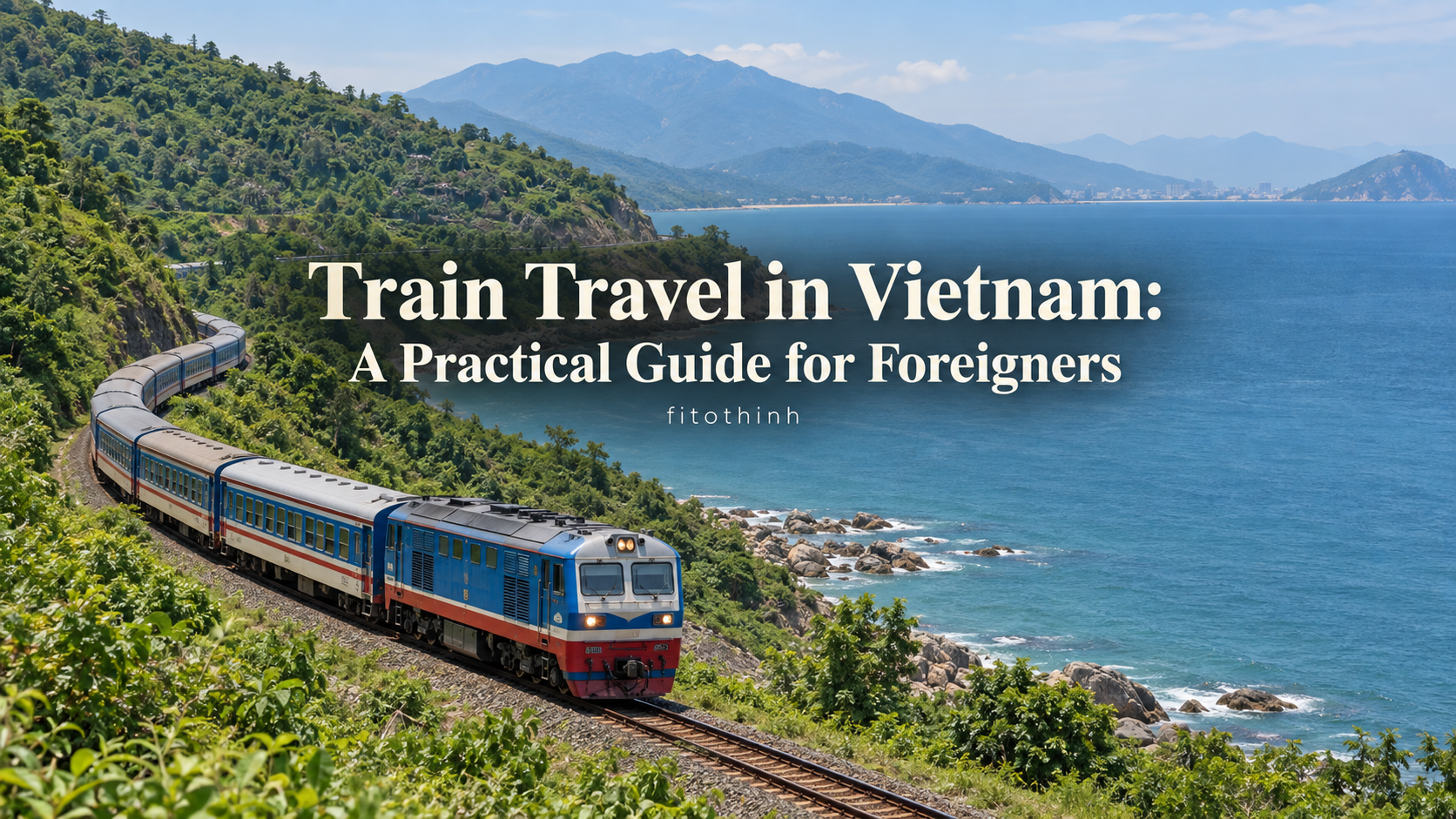
A train winding above the sea near Hai Van Pass and a long overnight journey in a shared sleeper cabin are both Vietnam train travel. They are also very different ways to spend your holiday. One asks for a few hours and a window seat; the other asks whether you can sleep through movement, station stops and someone opening a packet of snacks at midnight.
My recommendation is to use trains where they improve your route. Hanoi to Ninh Binh can be a useful countryside connection. Hue to Da Nang makes the journey itself worth your time. A sleeper can work well on selected longer sections, provided its arrival time suits your plans.
You do not need to cross the whole country by rail to enjoy the railway. This guide explains which journeys deserve consideration, how to book, what the different seats and berths actually mean, and what to expect at stations and on board. The goal is a comfortable trip with fewer surprises—especially the surprise that your “private sleeper” contains three other passengers.
Mục lục tóm tắt
Is Train Travel in Vietnam Worth It?
Yes, when the journey fits your itinerary. Trains offer scenery, room to move and a different perspective from highways and airports. They are particularly appealing for a manageable daytime journey or an overnight section between destinations you already want to visit.
The disadvantages are slower long-distance travel, variable sleep quality, shared facilities and possible delays. Station-to-hotel transfers still matter. A cheap berth arriving before dawn may require an extra hotel arrangement that removes the saving.
For a short nationwide holiday, combining trains with flights usually makes more sense than committing to one transport mode.
Vietnam Train Travel at a Glance
| Question | Practical answer |
|---|---|
| Best use? | Selected scenic, regional or overnight journeys |
| Official booking starting point? | Follow the ticket link from the railway website to dsvn.vn |
| Overnight class to consider first? | A soft-sleeper berth, commonly in a four-berth compartment |
| Does one berth buy a private cabin? | No; privacy must be explicitly booked and confirmed |
| Identification? | Passport details matching the booking; carry your passport |
| Standout scenic section? | Hue–Da Nang in daylight |
| Full Hanoi–Ho Chi Minh City journey? | Roughly a day and a half; check the selected service |
| Major booking pressure? | Tet, holidays and popular departures |
Understanding Vietnam’s Railway Network
Vietnam’s conventional north–south railway connects major stops including Hanoi, Ninh Binh, Dong Hoi, Hue, Da Nang, Nha Trang and Saigon. Individual trains have different stopping patterns: seeing a city on the railway map does not mean every service stops there.
Regional routes include Hanoi–Hai Phong and Hanoi–Lao Cai. Tourist-oriented products can use existing railway infrastructure with different carriages, service levels or booking arrangements.
These are conventional trains. Do not plan around proposed high-speed services or assume a future infrastructure announcement describes something you can book today.
What Is the Reunification Express?
“Reunification Express” is a commonly used name for north–south rail travel, rather than one single daily train. Services have their own identifiers, including SE train numbers. Your ticket’s train number, date and departure station identify your actual journey.
Vietnam Tourism’s transport guide provides an overview; use the railway’s live booking results for the service you will take.
Best Train Routes in Vietnam for Travelers
Hanoi to Ninh Binh
This is a sensible introduction to Vietnamese trains: a relatively short daytime journey between the capital and a rewarding countryside stop. Check the current departure and arrival times before comparing it with a van or car.
Ninh Binh Station is not Trang An or Tam Coc. Arrange onward transport to your accommodation or chosen boat pier. Staying overnight lets you enjoy the countryside after day-trip groups leave.
A train works particularly well when your Hanoi accommodation is convenient for the station. A shared van may be easier if its confirmed pickup and drop-off points are closer to your hotels.
Hanoi to Lao Cai: The Railway Connection for Sapa
The overnight train reaches Lao Cai, not Sapa. You then need road transport into the mountains.
Compare the whole journey with a direct road service, including both transfers and your arrival arrangements. Ask your hotel about luggage storage, breakfast and early check-in; an early arrival does not automatically include a room.
Tourist sleeper-carriage brands may be available on this route. Check the actual compartment layout, inclusions and ticket-collection procedure rather than choosing from promotional photographs alone.
Hue to Da Nang: The Train I Would Choose for the View
This section brings the railway close to the coast around Hai Van Pass, with sea, hills and the Lang Co area along the journey. Choose a departure that crosses the scenic section in daylight.
The dedicated Hue–Da Nang Heritage Connection service is another option alongside applicable regular trains. Check the dated booking result for journey length and stops rather than relying on an old timetable screenshot.
Ask the seller for a coastal-side window seat, but do not assume a seat number guarantees the same carriage orientation on every departure. Keep photography inside permitted passenger areas.
For Hoi An, continue by road from Da Nang: Hoi An has no railway station. Include this transfer when comparing total cost and arrival time.
Selected Central and Southern Routes
A longer section toward Nha Trang, or Nha Trang–Ho Chi Minh City, can suit travelers who want an overnight rail experience. Choose according to sleeping hours, arrival time and your actual route.
A night train can save a hotel night, but it also hides much of the landscape. If scenery is the reason for booking, inspect which part of the journey occurs after sunset.
September 2026 update: The railway has introduced HQ1/HQ2 heritage services between Hue and Tho Loc, associated with the wider Phong Nha heritage journey. The railway’s launch announcement identifies the rail endpoints; Phong Nha still requires onward transport. Confirm the current operating date, chosen station and transfer before booking.
Should You Take the Train From Hanoi to Ho Chi Minh City?
Allow roughly a day and a half on board, depending on the service. That is a substantial commitment on a 10–14-day holiday.
The full journey suits rail enthusiasts, travelers with generous time, or someone specifically seeking a long rail experience. For most first-time visitors, separate sections offer a better balance: leave the train, explore a destination, and continue when ready.
Train or Flight in Vietnam?
| Factor | Train | Domestic flight |
|---|---|---|
| Long distances | Substantial travel time | Usually much faster overall |
| Access | Stations may be convenient for city stays | Include airport transfers and check-in |
| Experience | Scenery, movement, sleeper options | Primarily an efficient connection |
| Rest | Possible in a berth; quality varies | Usually a short seated journey |
| Price | Depends on train, date and class | Depends on fare, baggage and demand |
| Connections | Allow for delays | Allow for delays and separate-ticket risks |
Compare door-to-door time: hotel checkout, station or airport access, waiting, the journey itself and onward transfer. Neither a flight’s scheduled duration nor a train’s arrival time tells the whole story.
Buses can reach places the railway does not, including Sapa and Hoi An. Private cars may make short regional transfers easier for families or groups. Compare the actual pickup point, luggage arrangements and comfort—not simply the cheapest advertised fare.
Vietnam Train Classes Explained
Names and configurations vary by service. The booking diagram and confirmed product description should guide your choice.
| Class | What to expect | Best suited to |
|---|---|---|
| Soft seat | Padded seating, commonly in an air-conditioned carriage | Short or moderate daytime journeys |
| Hard seat | More basic seating where offered | Short trips when budget matters most |
| Soft sleeper | Commonly four berths: two lower and two upper | Overnight travel |
| Lower-cost or hard sleeper | Often six berths with tighter space | Travelers comfortable with less room |
| Premium or two-berth product | Available only on selected services/products | Travelers buying a specific upgraded experience |
Soft sleeper describes a berth category, not a hotel room. A compartment normally remains shared unless your reservation explicitly gives you exclusive use.
Private tourist carriages can have separate branding while traveling as part of a railway service. Booking conditions, amenities and customer support may come from that carriage operator. “VIP” alone tells you very little: ask how many berths are inside and exactly what you are buying.
Which Train Class Should You Book?
For a daytime scenic section, start with a soft seat. For an overnight journey, I would normally consider soft sleeper first if the budget allows.
Lower berths are easier to access and often more practical for older passengers. Upper berths require climbing and may feel restrictive. A lower berth does not make the station, train entrance or toilet step-free; travelers with mobility needs should confirm the whole boarding process.
Couples buying two berths should expect other passengers unless exclusivity is confirmed. Families should reserve suitable berths together and ask about child ticket rules using each child’s age and nationality. Do not assume a discount found on a general travel blog applies to your family.
How to Book Vietnam Train Tickets
Official Booking and Reputable Agents
The corporate railway website links to dsvn.vn for online ticket sales. Start there if unsure about a website’s identity. An agency may be useful for English-language support or payment assistance, but a railway-themed name or logo does not make it the official seller.
You can also enquire and buy at a station ticket counter, subject to availability. Bring your passport and written journey details.
Booking Checklist
- Select the correct departure and arrival stations and your Vietnam-local travel date.
- Compare train numbers, departure times and arrival dates, including overnight arrivals.
- Choose the carriage and seat or berth from the available layout.
- Enter your full name and passport information carefully, matching the document.
- Check your email address, fare conditions and any agency charges.
- Pay using a method currently offered by the seller.
- Confirm successful ticket issuance and save the ticket offline.
The railway’s passenger identification rules make accurate booking details important. Carry your original passport for checks.
E-Tickets and Payment
An unpaid reservation, payment attempt or agency order receipt is not necessarily a valid travel ticket. Make sure you have the issued ticket or complete any explicitly required collection procedure.
Foreign-card acceptance can depend on the payment channel and your bank. If payment fails, check whether the transaction or ticket succeeded before trying repeatedly. A station counter or reputable agent can be a fallback.
Keep an offline copy of the ticket, its booking reference and the seller’s contact details. Your phone battery is part of your travel preparation.
How Far Ahead Should You Book?
For ordinary dates, book once your route is settled if you need specific berths together. Weekends, public holidays and sought-after sleeper products deserve earlier attention.
Tet needs separate planning. Sales may open well in advance and operate under special conditions. Do not assume tickets always become available a fixed number of days before departure; releases can differ by route and period.
If a search returns nothing, establish whether sales have opened, the train operates that day, or the desired allocation has sold out before changing your entire itinerary.
Prices, Changes and Refunds
There is no useful nationwide “train ticket price.” Route, train, departure date, berth position and service level all affect the fare. Compare the final total, including booking fees and station transfers, with your alternatives.
Read the conditions before payment. The operator’s 2026 fare and refund policy contains route-specific provisions. Promotional, tourist-carriage and holiday tickets can differ. Contact your seller promptly if plans change; do not assume a ticket can be edited or refunded immediately before departure.
How to Read Your Train Ticket
| Ticket wording | Meaning |
|---|---|
| Mác tàu | Train identifier |
| Ga đi / Ga đến | Departure / arrival station |
| Ngày đi / Giờ đi | Departure date / time |
| Toa | Carriage |
| Chỗ | Assigned seat or berth |
Also check passenger details, arrival date and booking reference. Booking systems commonly use Sai Gon for the Ho Chi Minh City railway station. “Ga” simply means station; it is not an additional destination.
What to Expect at Vietnamese Train Stations
For an unfamiliar station, I suggest arriving 30–45 minutes early, with extra margin during busy periods. This is a planning buffer, not a universal railway deadline; follow any earlier instructions from your operator.
Confirm the train and boarding location with staff. Find the correct carriage and assigned place rather than following the largest group of passengers. Platforms, steps and carriage entrances can make a heavy suitcase surprisingly unhelpful.
At your destination, use the station named on your ticket when arranging pickup. For Lao Cai, Ninh Binh and Da Nang, tell the driver your actual hotel—not simply “Sapa,” “Trang An” or “Hoi An”—and confirm the meeting point and price.
What a Vietnam Sleeper Train Is Really Like
A sleeper is a compact shared space that moves, vibrates and stops during the night. Some people sleep well; others enjoy the experience but feel tired the following morning. Avoid scheduling your most demanding activity immediately after arrival.
Bedding and Air Conditioning
Bedding is normally supplied in sleeper accommodation, although quality and presentation vary. A personal liner is optional. Bring a light layer because carriage air conditioning may feel cool even when the weather outside is hot.
Toilets and Washing
Facilities vary by carriage. Carry tissues, hand sanitizer and basic toiletries. Do not assume a shower is available; plan to wash properly before departure or at your accommodation afterward.
Food and Drinking Water
Food service varies by train and departure. Bring drinking water and enough familiar snacks to cover delays or unsuitable meal options. Travelers with allergies or dietary restrictions should carry something they know they can eat.
Do not step off to buy food unless staff confirm there is enough time and it is permitted. A station stop is not a reliable invitation to explore the platform.
Wi-Fi, Phone Signal and Power
Mobile reception can drop, especially through tunnels and remote sections. Wi-Fi and usable sockets are not something to build essential work around. Charge devices beforehand and download maps, reading and entertainment.
For digital nomads, a train can be good reading time. Treat a scheduled video call as a reason to choose another travel window.
Luggage on Vietnam Trains
Bring bags you can lift and manage through narrow spaces. Use designated storage and keep aisles and exits clear. Keep your passport, phone, money and medication in a small personal bag close to you.
Check the operator’s current allowance and arrangements for oversized luggage, bicycles or other unusual items before buying. Passenger luggage and separately transported goods are different services; a train ticket is not permission to bring anything aboard.
A modest suitcase or backpack is easier than several heavy bags, particularly when boarding at an intermediate stop.
Is Train Travel in Vietnam Safe?
Use normal travel precautions: keep valuables secure, confirm your assigned carriage and speak to train staff if something feels wrong. Solo women should consider their comfort with a potentially mixed shared cabin and choose a booking arrangement accordingly.
Supervise children around platforms, steps and carriage doors. Stay off railway tracks, obey barriers and never lean from doors or windows for photographs. An attractive railway scene does not make the tracks a safe walking route.
During serious weather, check railway service notices and Vietnam’s national weather authority. Heavy rain, flooding or landslides can disrupt travel. Follow operator instructions rather than an old itinerary screenshot.
Sleeper Train Etiquette
Keep voices low at night and use headphones. Store luggage within your own space, respect assigned berths and ask before sitting on someone else’s lower berth.
Be considerate with lighting and strongly scented food. Prepare your small bag before others sleep, and gather your belongings before your stop. Shared cabins work better when nobody has to search noisily for a charger at 3 a.m.
Night Train or Day Train?
Choose a day train for scenery and a night train when the schedule creates a useful overnight connection. Compare actual departure and arrival times: a late departure followed by a very early arrival may provide little sleep.
Allow a gentle morning after a sleeper. A saved hotel night is less valuable if you spend the next day exhausted.
What to Pack for an Overnight Train
- Passport, offline ticket and seller contact details.
- Phone, charger, power bank and downloaded entertainment.
- Earplugs, eye mask and headphones.
- Light layer, comfortable clothes and easy-to-manage footwear.
- Tissues, sanitizer, toothbrush and essential medication.
- Drinking water and a small supply of snacks.
- A compact personal bag for valuables and overnight essentials.
Keep these accessible so you do not need to unpack your main suitcase inside the compartment.
When I Would Skip the Train
I would reconsider a journey that creates backtracking, an awkward overnight arrival, an inaccessible berth or a very long crossing during a short holiday.
I would also avoid relying on a long train immediately before an international flight. Delays can happen; reaching your departure city the previous day is often the more comfortable choice. Insurance coverage depends on the policy, not simply on having bought insurance.
When serious weather affects operations, or essential work requires reliable connectivity, another transport plan—or postponing travel—may suit you better.
How to Use Trains in a Two-Week Vietnam Itinerary
For a Vietnam 2 week itinerary, I would use rail selectively:
- Hanoi–Ninh Binh: consider a daytime train and arrange the countryside transfer.
- Ninh Binh–Central Vietnam: compare an appropriate sleeper with returning toward Hanoi’s airport and flying. Assess the whole day, including hotel access.
- Hue–Da Nang: choose daylight if Hue already belongs in your route. Adding Hue requires removing time elsewhere.
- Da Nang–Ho Chi Minh City: a flight usually protects more sightseeing time on this particular two-week route.
Travel month also matters. Our Vietnam in November guide explains why Central Vietnam may need more weather flexibility while conditions differ in the north and south.
Common Mistakes Foreign Travelers Make
- Treating “Reunification Express” as one bookable train.
- Reserving the entire country crossing without counting the holiday time involved.
- Traveling at night through the landscape they wanted to see.
- Choosing an upper berth despite difficulty climbing.
- Assuming one berth—or two tickets—buys a private cabin.
- Entering passport details incorrectly or keeping only an unpaid reservation.
- Mistaking an agency’s branding for official railway status.
- Leaving Tet bookings until the last minute.
- Making a tight onward flight connection.
- Forgetting the transfer from station to actual destination.
Fito’s Local Tips for Train Travel in Vietnam
- Compare hotel-to-hotel costs before choosing the cheapest ticket.
- Give a scenic journey a window seat and daylight.
- Confirm berth arrangements before paying for a family booking.
- Save tickets offline while you still have reliable internet.
- Ask about luggage storage if your train arrives before check-in.
- Keep a light layer accessible, even in hot weather.
- Pack breakfast if your arrival time falls before cafés or hotel service.
- Tell your pickup driver the train number as well as the scheduled arrival.
- Leave the first hours after a night train flexible.
FAQ
Is train travel in Vietnam safe for tourists?
It is a practical option for many visitors. Keep valuables close, use official boarding areas and follow staff instructions, especially during disruptions.
How do foreigners book Vietnam train tickets?
Book through the official platform, a station counter or a reputable agent. Use accurate passport details and confirm that a valid ticket has been issued.
What is the official Vietnam Railways ticket website?
The railway’s corporate website links directly to dsvn.vn for online ticket sales. Start from that verified link if unsure about a seller.
What is the difference between soft sleeper and hard sleeper?
Soft sleeper commonly means four berths with more space. Lower-cost hard-sleeper compartments often contain six; check the actual carriage diagram before booking.
Is the Reunification Express one train?
No. It commonly refers to north–south services collectively. Your train number identifies the specific departure.
How long is the Hanoi to Ho Chi Minh City train?
Expect roughly a day and a half, with duration varying by service. Use your dated booking result for the scheduled arrival.
Is a Vietnam sleeper train comfortable?
Comfort depends on the carriage, berth and your ability to sleep with noise and movement. Soft sleeper is a sensible starting point, but hotel-quality rest is not guaranteed.
Can I take luggage on Vietnam trains?
Yes, within the applicable rules. Confirm restrictions for large or unusual items and bring luggage you can lift and store without blocking others.
Is the Hue to Da Nang train worth it?
It is a strong choice when both cities fit your itinerary and you travel in daylight. Include onward road transport if your destination is Hoi An.
Should I take the train or fly in Vietnam?
Choose rail when the experience or convenient regional connection adds value. For long distances on a short nationwide trip, flying often preserves more time at your destinations.
Final Thoughts: Which Vietnam Train Journeys Are Worth Taking?
The best Vietnam train travel choices fit the time you have: a countryside connection to Ninh Binh, a daylight journey between Hue and Da Nang, or a thoughtfully chosen sleeper section.
Choose the route, class and arrival time together. A good railway experience begins before you reach the platform—with a journey that belongs in your trip.
Need help choosing your route? Fito can help combine trains, flights and road transfers around your dates, interests, budget and preferred pace. Get in touch for a practical itinerary with enough time to enjoy the places between the stations.
Book directly with us:
- Hotline Compass Stay: +8470 404 8184 (Hotline, Zalo, Whatsapp)
- Hotline Fito Thinh: +84 905 835 538 (Hotline, Zalo, Whatsapp)
- Instagram: compass.stay
- Apply directly via https://www.vietnam-visa.in/apply-vietnam-visa/
- Book a flight to Vietnam via Agoda
- Booking Hotel Việt Nam