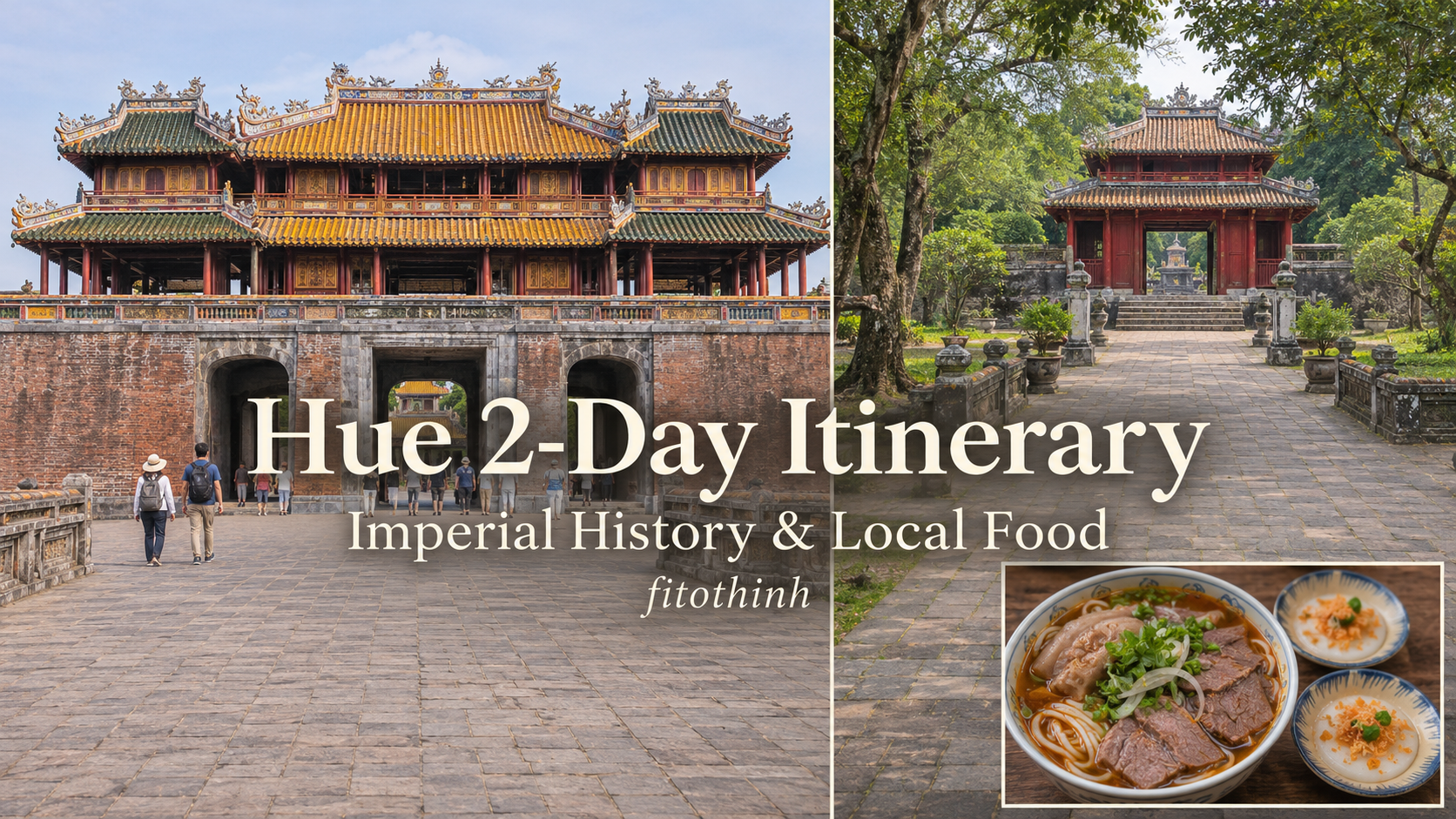
Two days in Huế works best when you stop trying to meet every emperor. This Hue 2 day itinerary gives the Imperial City a proper morning, follows the Perfume River to Thiên Mụ, then compares two royal tombs on the second day. Between those visits, there is time for bún bò, little steamed cakes and a meal that has absolutely no interest in dressing you as royalty.
My recommendation is simple: understand the capital first, then explore the personalities behind its monuments. Minh Mạng and Khải Định make a particularly useful pair because their tombs look so different. Choose Tự Đức instead if gardens matter more to you than formal geometry.
Food belongs inside this plan, not in whatever twenty minutes remain before the driver returns. Huế rewards small portions, patient looking and the occasional decision to sit down. You will find realistic visiting windows, ticket arithmetic, transport choices and weather alternatives below. The goal is to leave understanding something about the city—not merely owning photographs of several handsome gates.
Mục lục tóm tắt
Is 2 Days Enough for Hue?
Yes, two full days are enough for a meaningful first visit: the Imperial City, Thiên Mụ, two contrasting tombs and several local meals.
A Hue 2 days 1 night trip works if you arrive early on Day 1 and leave late on Day 2. Two nights are more comfortable: arrive the previous evening, enjoy two full days, then depart after sightseeing. Stay a third night if you also want an unhurried second evening.
Add a third sightseeing day for Gia Long’s tomb, An Định Palace, Thanh Toàn Bridge, countryside, craft villages or deeper food exploration.
Hue 2-Day Itinerary at a Glance
These are planning windows, including breaks—not timed reservations.
| Time | Day 1: capital and river | Day 2: tombs and everyday Huế |
|---|---|---|
| 07:00–08:00 | Bún bò breakfast; reach the Imperial City | Breakfast; meet your driver |
| 08:00–12:00 | Imperial City, allowing 3–4 hours | Minh Mạng, then Khải Định, with transfers |
| 12:00–14:00 | Cơm hến or cakes; proper rest | Return to town; bánh khoái or vegetarian lunch |
| 14:00–16:30 | Thiên Mụ and river landscape | Café, optional market or neighborhood time |
| Evening | Dinner, chè, short riverside walk | Another local meal or onward travel |
Both tombs sit in the morning to avoid driving back out after lunch.
A Quick History of Imperial Hue
Gia Long established the Nguyễn dynasty in 1802. Across thirteen emperors, Huế served as the dynasty’s capital until monarchical rule ended in 1945.
The UNESCO-listed Complex of Hué Monuments, inscribed in 1993, extends beyond the Citadel. Royal tombs, religious monuments and ritual sites belong to the wider imperial landscape.
The river matters to that story. Hills, water and geomantic principles shaped the arrangement of buildings and ceremonial spaces. The Perfume River is more than somewhere to photograph sunset: it helps explain why these monuments stand where they do.
War damage and continuing conservation also shape today’s visit. You will encounter surviving buildings, restored structures and reconstructed spaces.
Day 1: Understand the Imperial Capital
Breakfast: Bún Bò Huế
Start around 07:00 with a shop serving breakfast near your accommodation. Ask the previous evening which nearby place will actually be cooking when you need it; a famous name is less useful than an open kitchen.
Bún bò Huế combines round rice noodles with a broth commonly built from beef and pork bones, lemongrass and mắm ruốc, fermented shrimp paste. Beef, pork, crab sausage and other toppings vary. Chili contributes flavor, but you can ask for ít cay, meaning less spicy, where preparation allows.
This is its own noodle dish, not “spicy phở.” A broth already seasoned in the pot cannot always be made mild—or shellfish-free—at the table.
Hue Imperial City: Give It a Morning
Aim to enter around 08:00 and reserve three to four hours. Start with Ngọ Môn, the Meridian Gate, then follow the current signed route toward the ceremonial court and Thái Hòa Palace. Continue through selected royal residential spaces, temples and gardens rather than racing along every corridor.
Thái Hòa helps explain royal ceremony and authority. Huế’s tourism department reported the restored Nguyễn throne’s return to the palace on 4 June 2026. That supports including it in your plan, but conservation barriers and room access can still change.
At the entrance, ask three useful questions: which areas are open today, where does the recommended route finish, and which interpretation services are available? The authority lists audio guides, human guides, electric vehicles and VR experiences. Availability, routes and charges need checking; electric transport does not remove every threshold or walking section.
Choose an audio guide if you like pausing independently. A good human guide adds context about ceremony, colonial pressure and restoration.
Citadel, Imperial City and Forbidden Purple City
| Term | What it means |
|---|---|
| Kinh Thành / Citadel | The larger fortified capital |
| Hoàng Thành / Imperial City | The royal and administrative precinct within it |
| Tử Cấm Thành / Forbidden Purple City | The more restricted royal residential area inside the Imperial City |
“Đại Nội” is the visitor term you will commonly see for the central palace complex.
Current Heritage Hours
The heritage authority’s published schedule, checked 11 November 2026, distinguishes ticket sales from closing:
| Season | Ticket sales | Visitor closing time |
|---|---|---|
| 16 March–15 October | 06:30–17:30 | 18:30 |
| 16 October–15 March | 07:00–17:00 | 18:00 |
Use this general schedule for planning the Imperial City and the principal managed tombs, subject to site notices. It is not an independently confirmed timetable for Thiên Mụ.
Local Lunch: Cơm Hến or Huế Cakes
After the palace, eat and rest. Cơm hến combines rice with small clams and contrasting textures: herbs, vegetables, peanuts and crisp toppings, with seasoning varying by cook. Bún hến uses rice vermicelli. The dish is closely associated with Cồn Hến and the river, but you need not cross town for a ceremonial “original bowl.”
Shellfish, peanuts, shrimp paste and fish sauce can be involved. Removing visible clams does not make the dish suitable for a severe allergy.
Alternatively, share bánh bèo, bánh nậm and bánh bột lọc. Order a small selection first; you can always ask for more. Huế’s little dishes make curiosity much easier than ordering three large lunches.
Thien Mu Pagoda
Allow roughly 45–60 minutes, plus travel. From a central base, budget approximately 15–25 minutes by car in normal conditions; your actual pickup point matters.
Thiên Mụ offers a religious and landscape counterpoint to the palace. Look beyond its familiar seven-storey tower and give the grounds some quiet attention. This remains a place of worship.
Cover shoulders and knees, keep voices low, follow interior photography signs and avoid blocking worshippers. Ask before close portraits of monks.
Perfume River: Boat or Road?
Take a taxi, arranged car or ride-hailing vehicle for straightforward transport. Confident cyclists can consider a suitable route after checking traffic and weather.
A dragon boat is optional. It suits travelers who enjoy slow river views, but ordinary tourist boats may be simple vessels rather than luxury cruises. Before agreeing, confirm the complete price, duration, landing point, waiting time and whether the journey is one-way or return.
If rain is heavy or river conditions are poor, use road transport—or postpone.
Evening Food and Chè
Keep dinner flexible: cakes if lunch was substantial, a rice meal if it was light, followed by chè Huế. This broad family of sweet soups and desserts includes combinations of beans, lotus seeds, corn, fruit and other ingredients.
Take a short riverside walk if conditions suit.
Day 2: Meet the Emperors Through Their Tombs
Leave around 08:00 after breakfast. For the default route, allow 30–45 minutes from central Huế to Minh Mạng, 20–30 minutes between Minh Mạng and Khải Định, and 20–35 minutes back to town. These are conservative planning estimates, not live traffic measurements.
With two visits, transfers and short breaks, expect a morning of roughly four to five hours. Arrange lunch back in town around 12:30–13:00 rather than promising a precise noon arrival.
Minh Mang Tomb
Give Minh Mạng 60–90 minutes. Its formal axis, water and ordered layout provide a strong introduction to imperial landscape design.
Walk slowly enough to notice the relationships between courtyards, bridges and views. For photographs, look for symmetry and reflections where conditions allow.
Khai Dinh Tomb
Allow 45–60 minutes at Khải Định. Its steep approach and richly decorated interiors create a striking contrast, combining Vietnamese and European influences.
Expect substantial stairs and an exposed climb. Pause before ascending, carry water and consider another tomb if stairs are unsuitable. Inside, follow photography restrictions and let others enjoy the decorative details without a permanent wall of phones.
Tu Duc Alternative
Prefer gardens and a gentler atmosphere? Replace Minh Mạng with Tự Đức, allowing 60–90 minutes. Its landscaped setting connects well with the emperor’s interest in poetry.
This is an alternative, not an automatic third stop. Nor does a garden setting guarantee step-free access. Confirm the specific route if uneven paths or thresholds present difficulties.
Which Two Tombs Should You Choose?
| Tomb | Best for | Main character | Trade-off |
|---|---|---|---|
| Minh Mạng | First-time heritage visits | Formal landscape and symmetry | More walking |
| Khải Định | Architectural contrast | Ornate decorative detail | Stairs and concentrated crowds |
| Tự Đức | Gardens and poetry | Landscape-led design | Rewards patient looking |
| Gia Long | A longer, quieter excursion | Expansive rural setting | More travel time |
| Dục Đức | A shorter urban visit | More modest scale | Less monumental impact |
Default: Minh Mạng + Khải Định. Garden preference: Tự Đức + Khải Định. If stairs are the issue, investigate Minh Mạng + Tự Đức with an access-aware guide.
Thiệu Trị and Đồng Khánh are possibilities for a longer stay. There is no prize for completing all seven tombs in two days.
Optional Thuy Xuan Incense Stop
Allow 30–45 minutes only if Thủy Xuân fits your actual route, particularly when visiting Tự Đức. Some displays are arranged specifically for photography; this is a working commercial area, not an untouched village set.
Ask before photographing people. If using a vendor’s display extensively, ask about their expectations and consider buying something.
Lunch: Bánh Khoái, Bún Thịt Nướng or Vegetarian Huế
Bánh khoái is a crisp rice-flour pancake, often with shrimp, pork, sprouts and egg. Its substantial dipping sauce can contain peanuts and pork liver; sauces deserve the same ingredient questions as the main dish.
For another option, try bún thịt nướng, rice vermicelli with grilled pork, vegetables and sauce, or bánh ướt, soft rice sheets with accompaniments.
A quán chay is a vegetarian restaurant. Huế’s Buddhist food traditions make a vegetarian lunch a meaningful local choice. Vegan travelers should still confirm broth, fish sauce, egg and dairy.
Local Afternoon, Market or Dessert
Choose one: a neighborhood café, a short walk around Gia Hội, or Đông Ba Market. The city’s tourism listing gives the market’s general hours as 06:30–19:00; individual stalls keep their own hours, so avoid relying on a late visit for a particular dish.
Ask prices before ordering and keep aisles clear.
Food-first version: keep the same two tombs, then spend the afternoon on one shared snack and chè. History-first version: replace leisure time with the Royal Antiquities Museum after confirming access. Only serious enthusiasts with efficient transport should consider a third tomb; it makes a substantially busier day.
What to Eat in Hue
Use this list across both days rather than attempting everything at one sitting.
| Dish | What to expect | When it fits |
|---|---|---|
| Bún bò Huế | Aromatic noodle soup; toppings vary | Day 1 breakfast |
| Cơm hến / bún hến | Clams with rice or noodles and crunchy accompaniments | A modest lunch |
| Bánh bèo | Small steamed rice cakes, commonly shrimp-topped | Shared snack |
| Bánh nậm | Soft rice-flour parcels in leaves, often shrimp/pork-filled | Cake selection |
| Bánh bột lọc | Chewy, translucent tapioca dumplings, often shrimp/pork-filled | Cake selection |
| Bánh ram ít | Soft sticky-rice bite on a crisp base | A contrasting texture |
| Bánh khoái | Crisp savory pancake with dipping sauce | Day 2 lunch |
| Cơm chay | Vegetarian rice meal with several accompaniments | Either day |
| Chè | Sweet soup or dessert; ingredients vary | Evening treat |
For venue selection, ask for a nearby specialist serving the dish at your intended meal time, then check its current menu. This guide avoids recycling old restaurant addresses as verified recommendations.
Choose careful food handling, clean utensils and food freshly cooked through. Turnover is useful, but a local queue does not guarantee safety. If water or raw-produce handling is uncertain, choose cooked alternatives.
For severe allergies, use a translated allergy card and discuss sauces, broth and shared equipment. If staff cannot confirm suitability, choose elsewhere. Follow your clinician’s travel plan and carry prescribed emergency medication.
Imperial Cuisine vs Everyday Hue Food
Court culture influenced culinary presentation and refinement, but Huế’s food also comes from ordinary homes, markets and religious kitchens. Avoid the tempting claim that every little cake was invented for an emperor.
A royal-style dinner can be enjoyable if you appreciate formal service and presentation. Ask what the meal includes and whether costumes or performances are part of it. Tourist theatricality is not proof of a historically exact banquet.
You do not need one. A bowl of cơm hến and a thoughtful vegetarian meal can be equally valuable parts of understanding the city.
Where to Stay
| Base | Suits | Check before booking |
|---|---|---|
| South bank, central restaurant area | Easy meals, cafés and broad accommodation choice | Evening street noise and pickup access |
| North bank, Citadel side | Early palace access and historic surroundings | Walking distance to dinner and transport |
For a first visit, prioritize a central location, reliable transport access and somewhere comfortable to rest at midday.
Older addresses may still say Thừa Thiên Huế. Huế became a centrally governed city on 1 January 2025; the heritage city has not moved. Match the property name, street and map pin rather than relying only on an old ward label.
Getting to Hue
Phú Bài Airport: approximately 15 km from the city according to Vietnam Tourism. Allow around 30–45 minutes for a central hotel transfer in normal conditions, plus airport procedures. Check your airline’s actual flight, terminal and check-in instructions; arrange a taxi or confirmed pickup rather than assuming a particular shuttle operates.
From Đà Nẵng: compare train, private car and currently bookable bus/minivan services. Allow approximately 2–3 hours by direct road transfer in ordinary conditions, longer for stops. A scenic Hải Vân Pass itinerary must be agreed explicitly; a direct vehicle may use the tunnel.
The official heritage-train website advertises the coastal connection, with displayed journeys ranging roughly three to four hours. Confirm the selected date’s departure, arrival and fare when booking. See our Vietnam train travel guide for wider planning.
From Hội An: allow approximately 3–4 hours by direct road transfer, longer with sightseeing or disruption. Hội An has no mainline passenger railway station; taking the train requires a road connection to Đà Nẵng.
Leaving After Day 2
A late-afternoon private transfer can work after the morning tomb route and lunch. An evening train to Đà Nẵng may also fit if one is available for your date; onward travel to Hội An adds another transfer.
For a daylight heritage train, you may need to leave earlier and drop the afternoon wandering. Another Huế night protects dinner and simplifies a next-morning departure. Avoid a tight road connection to an essential international flight.
Getting Around Hue
Walk within central neighborhoods; use taxis or ride-hailing for longer urban journeys. The tombs are spread beyond the center, so arrange a car and driver for Day 2 or confirm return pickups before each ride.
Ask whether a quote includes waiting, parking, tolls and all chosen stops. A driver is not automatically a historical guide.
Solo travelers can compare a small-group tour with separate rides. Families often benefit from a vehicle waiting while they adjust the pace. A scooter is unnecessary; only consider riding with appropriate licensing, insurance and experience.
Best Time for This Itinerary
February–April is a useful target for milder sightseeing. February can still be cool and wet; the weather does not read calendar boundaries.
March–August generally brings warmer, sunnier conditions, with serious heat possible. Start early, carry water and protect the midday break.
September–February can bring rain, cloud and damp cooler spells, especially toward winter. The strongest rain and flood concerns are commonly associated with September–November. Pack a rain layer, shoes with grip and a light jacket for cooler periods.
For a wider winter route, compare Vietnam in January and Hội An in January.
Rainy-Day Version
On Day 1, use the safest manageable weather window for a shorter Imperial City route. Add a café, food stops or the Royal Antiquities Museum if open. An Định Palace is another possible substitute, but reaching it and moving around its grounds still involves exposure.
On Day 2, choose one tomb or postpone both if conditions warrant. Skip river travel in poor conditions. During flood warnings, follow local authorities and never enter floodwater for sightseeing. An indoor attraction is not a safe alternative if the journey there is unsafe.
Family and Mobility-Friendly Version
With young children, shorten the palace route, take a long lunch break and choose one tomb if heat or attention fades. Food tasting works well when you share a few small portions.
For mobility needs, ask about actual walking distances, steps, surfaces, toilets and electric-vehicle boarding. Minh Mạng or Tự Đức may suit some travelers better than Khải Định’s stairs, but neither should be promised as universally accessible. Choose by individual mobility, not age.
How Much Does Two Days Cost?
Heritage Tickets: Verified 2026 Reference for 2027 Planning
Prices in VND, checked 11 November 2026 against the Huế Monuments Conservation Centre price table and live ticket catalogue.
| Site or route | Adult | Child aged 7–12 | Checked |
|---|---|---|---|
| Imperial City | 200,000 | 40,000 | 11 Nov 2026 |
| Minh Mạng | 150,000 | 30,000 | 11 Nov 2026 |
| Tự Đức | 150,000 | 30,000 | 11 Nov 2026 |
| Khải Định | 150,000 | 30,000 | 11 Nov 2026 |
| Imperial City + Minh Mạng + Khải Định | 420,000 | 80,000 | 11 Nov 2026 |
| Imperial City + Tự Đức + Khải Định | 420,000 | 80,000 | 11 Nov 2026 |
Separate adult tickets for the default route total 200,000 + 150,000 + 150,000 = 500,000 VND. The listed combo saves 80,000 VND. Child tickets total 100,000 VND separately, saving 20,000 VND with the combo.
Before buying, confirm that the three-site ticket covers your two separate visiting days. The published material reviewed did not clearly establish its validity period. A four-site pass is listed at 530,000 VND per adult, with a published maximum validity of two days; buying it for only these three sites would cost 30,000 VND more than separate tickets.
Check the final booking total and child eligibility. The e-ticket terms say prices include VAT, may change, and paid tickets cannot ordinarily be edited or cancelled through the standard system.
Meals and Other Costs
These are editorial budgeting allowances, not surveyed city averages, restaurant quotes or verified 2027 prices:
| Item | Allowance in VND | Basis |
|---|---|---|
| Bún bò bowl | 35,000–70,000 | Per person |
| Cơm hến / bún hến | 20,000–45,000 | Per bowl |
| Cake selection | 50,000–120,000 | Shared order; size varies |
| Bánh khoái | 40,000–90,000 | Portion/venue dependent |
| Chè | 15,000–35,000 | Per serving |
| Casual restaurant meal | 100,000–250,000 | Per person, excluding alcohol |
Build your total from accommodation per room/night, heritage admission per person, tomb transport per vehicle, meals, arrival/departure transfers and an optional guide. Request dated hotel and vehicle quotes. One permanent “two-day total” would hide too many choices.
Heritage and Temple Etiquette
Wear comfortable shoes and modest clothing; cover shoulders and knees at pagodas and sacred spaces. Follow staff instructions about footwear, restricted rooms and photography.
Do not climb monuments, lean equipment against decorated surfaces or use flash where prohibited. Ask before close portraits. Early palace light, Minh Mạng’s geometry and late-afternoon river views can reward photographers, but access rules and weather come first.
Common Hue Itinerary Mistakes
- Trying to visit every royal tomb.
- Giving the Imperial City only an hour.
- Adding three tombs after the palace.
- Treating Thiên Mụ as a photo backdrop.
- Assuming a dragon boat is compulsory.
- Eating only bún bò.
- Mistaking a staged banquet for all Huế cuisine.
- Renting a scooter unnecessarily.
- Ignoring rain warnings and slippery stairs.
- Buying a combo without checking validity.
- Calling the entire UNESCO property “the Citadel.”
- Booking an early departure while claiming two full sightseeing days.
Fito’s Local Tips
- Protect the palace morning before adding anything else.
- Choose contrasting tombs, not the longest attraction list.
- Order a small cake selection, then decide whether to repeat.
- Keep chili additions separate where possible.
- Save your hotel’s exact pickup pin offline.
- Carry rain protection even when the morning looks agreeable.
- Agree waiting time with your driver before leaving town.
- Keep one meal ordinary; no royal costume required.
- Stop while you still enjoy looking. The next emperor can wait.
FAQ
Is two days enough for Hue?
Yes, for the Imperial City, Thiên Mụ, two tombs and local food. Arrival and departure must leave two genuine sightseeing days.
How long do I need at the Hue Imperial City?
Allow three to four hours for a first visit, with a shorter selected route for children or limited stamina.
Which royal tombs should I visit?
Start with Minh Mạng and Khải Định for contrast. Swap Minh Mạng for Tự Đức if gardens appeal more.
Is Minh Mang or Khai Dinh better?
Minh Mạng suits formal landscapes; Khải Định suits decorative architecture. Your interests and comfort with stairs decide.
Is Tu Duc Tomb worth visiting?
Yes, particularly for its landscaped setting. Use it as a deliberate alternative rather than another compulsory stop.
Do I need to see all the tombs?
No. Two carefully chosen visits are enough for this itinerary.
Is Thien Mu Pagoda worth visiting?
Yes, for the religious and river-landscape context, provided you visit respectfully and conditions permit.
What food is Hue famous for?
Bún bò, cơm hến, steamed cakes, bánh khoái and chè are useful starting points. Include a vegetarian meal too.
Can I visit without a motorbike?
Absolutely. Combine central walking with taxis, arranged transport or a guided tomb excursion.
Where should first-time visitors stay?
Choose a central south-bank base for dining convenience or the Citadel side for early heritage access.
What is the best time to visit?
February–April is a good starting point. Check forecasts: February can remain damp, while later months grow hotter.
Can I leave for Hoi An after Day 2?
Yes, with a confirmed late transfer and enough buffer. Staying another night preserves the second evening.
Two Days, Two Emperors, Many Small Meals
A good Hue 2 day itinerary connects the palace, the tombs and everyday food. Give each enough time and the former capital becomes easier to understand.
Huế complements Hội An’s trading-port history. Our lean Vietnam 10-day itinerary leaves Huế out by default because it deserves real time. With two weeks in Vietnam, Hanoi/Ninh Bình → Huế → Hội An → HCMC becomes easier to consider, with suitable transport days.
If Central Vietnam is becoming a sequence of hotel check-ins, ask Fito about custom itinerary planning. The useful question is where an extra night adds value—not how many gates fit before lunch.
Book directly with us:
- Hotline Compass Stay: +8470 404 8184 (Hotline, Zalo, Whatsapp)
- Hotline Fito Thinh: +84 905 835 538 (Hotline, Zalo, Whatsapp)
- Instagram: compass.stay
- Apply directly via https://www.vietnam-visa.in/apply-vietnam-visa/
- Book a flight to Vietnam via Agoda
- Booking Hotel Việt Nam