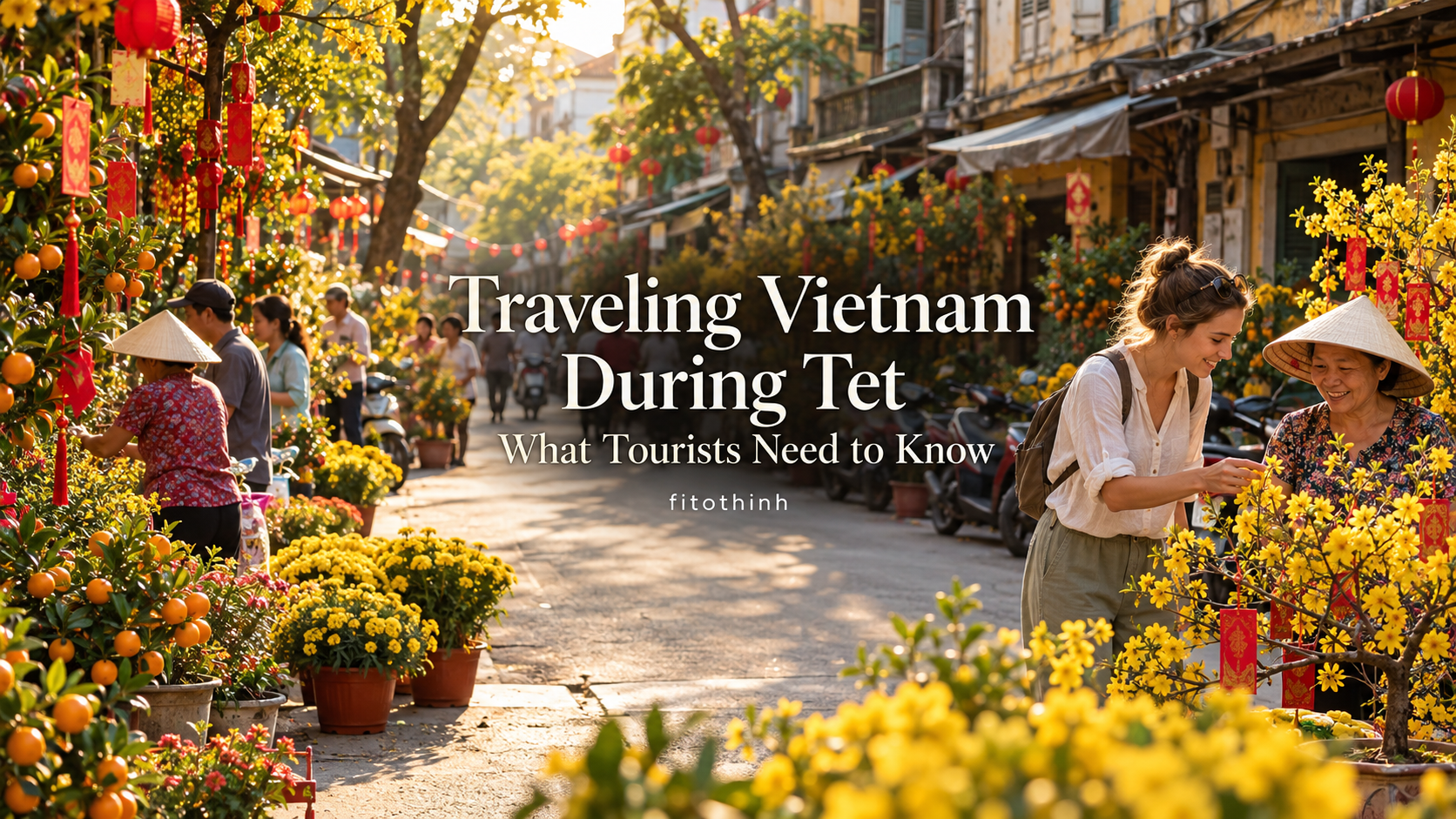
Traveling through Vietnam during Tet can feel like visiting two different versions of the same city. Before New Year, people carry flowers home, shopping streets fill up and transport bookings become urgent. On the first morning of the lunar year, a familiar neighborhood may suddenly seem remarkably quiet.
That contrast is part of the experience. Tết offers seasonal food, decorated streets, temple visits and a glimpse of how much family matters in Vietnamese life. But the celebration also changes the practical details of a holiday: your favorite restaurant may close, your preferred train berth may sell out and a normal tour timetable may no longer apply.
My advice is to plan the essentials early and leave the first days less crowded with commitments. Choose where you want to spend Tết, secure the journey there and know where you can eat. Then give yourself time to notice the change around you.
This guide explains the 2027 dates, the three phases of the holiday and how to enjoy them without depending on normal opening hours.
Mục lục tóm tắt
Is Tết a Good Time to Visit Vietnam?
Yes, if you value cultural atmosphere and can plan ahead. Slow travelers, photographers and repeat visitors may particularly enjoy seeing familiar cities differently.
It can frustrate visitors who want spontaneous intercity tickets, a long restaurant checklist or a new hotel every night. Families benefit from fewer moves and dependable meals. Solo travelers should ask whether their hotel or hostel has communal activities; a quiet city does not necessarily provide the social scene they expect.
Tết 2027 Dates at a Glance
| Date | What it means | Planning implication |
|---|---|---|
| Thursday, 4 February | Public-sector holiday begins; lunar 28 December | Holiday arrangements already in effect |
| Friday evening, 5 February | Tết Eve | Stay near your chosen base |
| Saturday, 6 February | Mùng 1: Lunar New Year’s Day, beginning Đinh Mùi | Strong family focus; check every essential service |
| 7–10 February | Mùng 2–5 | Variable openings and holiday travel |
| Thursday, 11 February | First day after the announced public-sector break | Not a universal business reopening date |
The official public-sector break is 4–10 February 2027, seven consecutive days. The government announcement also allows different arrangements for employers. Restaurants, hotels and shops do not all follow one closure calendar.
Mùng 1 on 6 February follows the announcement’s Gregorian–lunar mapping. Distinguish that New Year’s Day from the beginning of the public-sector holiday two days earlier.
Why Tết Changes the Way You Travel
Tết is organized around family reunion, remembrance and a fresh start. Staff, drivers, guides and restaurant owners also have homes to visit and celebrations to prepare.
That helps explain an apparent contradiction: ordinary city streets may become quieter while airports and beach destinations remain busy. Different people are traveling in different directions for different reasons.
The most useful planning question is therefore: What will this particular place be doing on this particular day?
The Three Phases of Tết
| Phase | What travelers may notice | Best approach |
|---|---|---|
| One to two weeks before New Year | Shopping, flowers, preparations and journeys home | Enjoy the street activity; secure transport |
| Tết Eve and Mùng 1–2 | Family celebrations, quieter neighborhoods, reduced services | Remain in one base with meals arranged |
| Around Mùng 3–5 and afterward | Gradual reopening, visits and return journeys | Resume plans only after confirming operations |
Before Tết: preparation becomes part of the scenery
Markets and shops offer flowers, gifts and decorations. Families prepare food and put their homes in order. This is often the most visually active phase for visitors who enjoy street photography and market life.
Leave space in the day for walking rather than booking every hour. Buy anything you specifically need before smaller businesses begin their breaks.
Tết Eve and the first days: slow down
If you arrive only on Mùng 1, you may miss much of the public preparation. A closed café does not mean you chose the wrong destination; it may mean the owners are having a rare family morning.
Plan a walk, a confirmed meal and perhaps a respectful temple visit. Leave room for rest instead of chasing a list of businesses that may not open.
After Mùng 3–5: reopening is gradual
Some services return early, others later. A restaurant reopening does not establish that its neighboring tour office has resumed trips. Return travel can also remain busy.
Vietnam Tourism’s Tết visitor guide supports this broad pattern of preparation, family time and changed services. Its historical event dates should not be used as a 2027 calendar.
Flights During Tết
Domestic flights continue operating. The challenge is securing suitable seats and managing busy travel days, not a nationwide airport shutdown.
Vietjet’s 2027 announcement covers travel from 22 January to 20 February 2027. This illustrates the wider travel window; it is not a definition shared by every airline.
Before Tết, journeys from major employment centers toward family hometowns can be heavily demanded. Afterward, return flows reverse. Check your route and direction rather than assuming all flights have the same price pattern.
Book essential flights once dates are stable, before optional activities. Compare baggage allowances, changes and total fares. Do not build a trip around the assumption that a cheap last-minute seat will appear.
Check the actual HCMC airport
For 2027, read the airport name and terminal on your airline confirmation. Government reporting describes a planned phased transition involving Long Thành and Tân Sơn Nhất, subject to implementation. That plan does not establish which airport your flight will use.
Reconfirm after schedule changes. Allow for any airport change between flights and avoid treating separate airports as neighboring terminals.
Follow your airline’s current check-in guidance, adding time for the road journey and holiday queues. A single fixed arrival rule cannot cover every airport and flight.
Trains, Buses and Local Transport During Tết
Trains
It operate during the holiday. The railway’s 2027 sales notice says individual ticket sales opened on 5 September 2026, including through dsvn.vn, stations and official agents.
Its operating announcement covers 23 January–25 February 2027, another reminder that travel demand extends beyond the statutory break.
Choose the correct station, date, berth and passenger details. Use official or authorized sellers, and keep your confirmed ticket accessible offline. Read the current exchange and refund terms before paying; older Tết conditions should not be assumed to apply in 2027. If a train is essential, secure it before accommodation that depends on its arrival.
Buses and limousine vans
Book with a reputable operator and confirm the exact pickup location, luggage arrangements and destination. A “city center” stop can be inconvenient if it is far from your accommodation.
Allow for road congestion and avoid tight connections after a long bus journey. Private transfers can help families coordinate luggage and stops, but they face the same roads.
Taxis, ride-hailing and airport transfers
Some services continue on Mùng 1, but driver supply, waiting times and prices may differ. Do not assume a normal app estimate guarantees a car at your required hour.
For Tết Eve, early departures or family arrivals, ask Fito to check an advance transfer. Confirm availability, the final holiday price, pickup instructions and the contact if plans change. For an SGN flight, use the Tân Sơn Nhất airport transfer guide alongside your airline’s current information.
Should You Change Cities During Tết?
Minimize unnecessary long-distance movement around Tết Eve and the first days. My default is to reach your chosen base beforehand and stay several nights.
A flight on Mùng 1 is not automatically a mistake. An unconfirmed flight, uncertain pickup and unknown hotel check-in arrangement together make a fragile plan.
If your dates force a holiday transfer, confirm the whole chain: transport, arrival assistance, accommodation access and food.
Is Vietnam Closed During Tết?
No. Availability changes business by business.
| Service | What may change | What to confirm |
|---|---|---|
| Family-run restaurants and cafés | Several days closed or shorter hours | Exact date and meal service |
| Hotels and serviced apartments | Staffing, breakfast or cleaning schedule | Check-in and support arrangements |
| Shops and markets | Closures or different trading hours | Essentials before the break |
| Museums and attractions | Special holiday timetable | Official opening notice |
| Tours | Guide, vehicle or supplier availability | Written departure confirmation |
| Banks | Branch services limited by holiday calendar | Payment alternatives beforehand |
A map listing marked “open” may still reflect ordinary hours. Contact the business directly and save its reply. “We are open during Tết” deserves a follow-up if you need breakfast at a particular time on 6 February.
Restaurants and Food: Make a Small Backup Plan
Before the first holiday days, identify two or three confirmed dining choices near your accommodation. A hotel restaurant can be useful, but ask whether it requires reservations or offers a special menu.
Keep simple breakfast food and snacks available, especially with children. Confirm a nearby convenience-store option instead of assuming every branch operates identically. Delivery apps may work with fewer restaurants or drivers; use them as another option rather than your entire food plan.
Ask about holiday surcharges before ordering or reserving. Some businesses apply them, others do not. Compare the final bill rather than assuming everything costs twice as much.
Food travelers should explore specialist dishes before Tết as well as during it. The holiday’s richest food traditions often happen at home, while a famous restaurant may be taking a break.
Hotels and Accommodation
Choose accommodation for the support you need during a slower week. A full-service hotel may provide dining and staffed assistance. An apartment can offer a refrigerator, cooking facilities and laundry, helping families manage simpler meals and longer stays.
Ask about your exact dates: who handles late check-in, what happens if access fails, whether cleaning changes and how urgent maintenance is handled. For self-check-in, download instructions before traveling.
I operate Compass Stay in central HCMC. Our published Soho apartment offers household facilities and shared living space, but 2027 Tết staffing, cleaning and transfer arrangements must be confirmed separately. The two-bedroom apartment guide helps you assess the layout; it is not a holiday-service guarantee.
Attractions, Temples and Day Trips
Check the attraction’s own holiday notice. Government museums, heritage sites and private attractions may use different schedules. Avoid promising yourself a particular museum on Mùng 1 until its hours are confirmed.
For Củ Chi, the Mekong, Ninh Binh or Ha Long, confirm both the operator and the relevant sites. A booking page accepting payment does not answer every question about holiday meals, guides or pickup arrangements.
Temples and pagodas may be especially active. Visitors can often observe respectfully, following local access rules. Wear modest clothing, keep voices low, follow footwear instructions and leave worshippers space. Avoid blocking entrances for photos or touching offerings.
What Vietnamese Families Do During Tết
Family gatherings, ancestor remembrance, shared meals and visits are central themes. Many households prepare before New Year so the first days can focus on relationships and renewal.
Customs vary across regions, generations and families. You may see new clothing, red envelopes, flowers and food offerings, but no single household represents every Vietnamese tradition.
For visitors, understanding the family focus makes the practical changes easier to appreciate. A reduced service schedule is often the visible result of someone’s journey home.
Tết Etiquette for Tourists
Xông đất: do not arrive uninvited
Some families attach significance to the first person who enters their home in the new year, choosing someone associated with good fortune. Do not casually drop in on Mùng 1, even if you met the family earlier in your trip.
If you are invited home
Confirm the time, dress neatly and follow your host’s lead. Greet older relatives respectfully, ask about shoes and consider a modest gift such as fruit or biscuits. Ask what is suitable if uncertain.
Do not move or step over altars and offerings. Request permission for close portraits, prayer or family rituals. A home invitation is a personal relationship, not an attraction ticket. Vietnam Tourism’s etiquette guidance provides useful background.
Lì xì: lucky money
Red envelopes are associated particularly with children and younger family members, with other practices depending on the household. Tourists are not expected to hand money to random children.
If invited into a family setting, ask your host whether participating is appropriate. Keep the gesture modest and personal; do not turn it into payment for photographs.
A greeting and appropriate clothing
Chúc Mừng Năm Mới means Happy New Year. A friendly greeting is a simple way to participate.
Red is festive, but visitors need not wear a costume or an entirely red outfit. Neat, respectful clothing matters more than rigid color rules. Pack primarily for the region’s weather, adding suitable coverage for temples and home visits.
Food to Try During Tết
| Food | What to look for |
|---|---|
| Bánh chưng | Square leaf-wrapped sticky-rice cake, commonly with mung bean and pork; strongly associated with northern traditions |
| Bánh tét | Cylindrical sticky-rice cake, especially familiar in central and southern traditions; fillings vary |
| Thịt kho trứng / thịt kho hột vịt | Southern-style braised pork and eggs |
| Giò/chả | Vietnamese sausage preparations appearing on many celebration tables |
| Pickled vegetables | Dưa hành or củ kiệu, among regional accompaniments |
| Mứt | Candied fruit and other sweet snacks offered with conversation and tea |
These are related regional traditions, not identical menus in every home. Vietnam Tourism’s Tết food feature describes several of these celebration dishes.
If you have dietary restrictions, ask about fillings, broth and sauces rather than judging by appearance. A rice cake may contain pork; a vegetable dish may use fish sauce. Arrange essential dietary needs before your restaurant options narrow.
Flowers, Decorations and 2027 Events
Northern displays commonly feature peach blossoms and kumquat trees; southern Tết is closely associated with yellow mai, or ochna blossoms. Look for the details in ordinary streets as well as organized displays.
Quảng Bá flower market is a familiar pre-Tết Hanoi option, but ask locally about current access and suitable visiting times. It is a working market: stay out of loading paths and request permission for close photographs.
Nguyễn Huệ Flower Street is a recurring HCMC attraction. Confirmed 2027 dates, access arrangements and city fireworks schedules were not located during this review. Check municipal and organizer announcements before planning a specific evening. Previous years’ programs do not confirm this year’s events.
Hanoi During Tết
Hanoi offers northern flower traditions, Old Quarter streets and cool-season atmosphere. Before New Year, allow time for preparations; during the first days, expect a different pace and narrower dining choices.
Use the Hanoi three-day itinerary as a geographic guide, not a promise that its attractions operate on the same holiday timetable. Put confirmed museum visits earlier and keep a flexible walking day for Mùng 1.
Ho Chi Minh City During Tết
HCMC offers southern flowers, generally warmer weather and a broad accommodation base. Some central streets can feel unusually calm after the pre-holiday rush, while active religious sites or confirmed events may attract crowds.
Choose a walkable base with verified food options. A quiet neighborhood does not mean road crossings are risk-free or that every taxi is immediately available.
Hội An, Central Vietnam and Beach Destinations
Hội An can suit a slower heritage stay, provided restaurant and site schedules fit. Huế and Da Nang also require individual checks; do not assume a published annual festival will operate on your exact dates.
Early-February weather differs by region: northern cold spells remain possible, central conditions are transitional and the south is typically warmer and drier. Use our seasonal planning guides for the weather details rather than treating Tết as one national climate.
For a beach holiday, Phú Quốc falls within a favorable seasonal period, but reserve flights and the room type you actually need. Read the Phú Quốc four-day itinerary before choosing your base.
Nha Trang, Da Nang and Vũng Tàu can attract domestic holidaymakers too. Quiet city neighborhoods do not imply empty resorts.
Where Should Tourists Spend Tết?
| Your priority | Base to consider | Main planning task |
|---|---|---|
| Northern traditions and winter streets | Hanoi | Dining backups and cold-weather clothing |
| Southern culture and warmer city days | HCMC | Confirm holiday services and event information |
| Smaller heritage setting | Hội An | Check sites, meals and transfers |
| Beach holiday | Phú Quốc | Secure transport and preferred accommodation |
| Family connections in a smaller town | Your hosts’ location | Agree on meals, transport and expectations |
For a first cultural visit, choose Hanoi or HCMC and stay across the transition from preparation to the first days. Smaller towns can be rewarding with local connections, but independent visitors may find fewer service alternatives.
A Smart Tết 2027 Travel Timeline
| Window | Planning focus |
|---|---|
| From 22 January | Airline holiday travel window already relevant; check your operator |
| Late January–3 February | Enjoy preparations; confirm accommodation, meals and onward travel |
| 4 February | Public-sector break begins |
| 5 February | Stay settled for Tết Eve |
| 6–7 February | Mùng 1–2: flexible local plans |
| 8–10 February | Mùng 3–5: reconfirm trips and openings individually |
| From 11 February | Public-sector break ends; business schedules and return travel still vary |
Sample Ten-Day Tết Itinerary: 2–11 February 2027
| Dates | Plan | Overnight base |
|---|---|---|
| 2–4 February, Days 1–3 | Arrive; see preparations; complete supplies and dining checks | Hanoi or HCMC |
| 5 February, Day 4 | Tết Eve; confirmed meal and local walk | Same city |
| 6 February, Day 5 | Mùng 1; slow morning and respectful temple visit if accessible | Same city |
| 7 February, Day 6 | Mùng 2; flexible neighborhood day | Same city |
| 8–9 February, Days 7–8 | Confirmed two-day excursion, or continue city stay | Ninh Binh from Hanoi, or Mekong from HCMC |
| 10 February, Day 9 | Return to departure city; buffer and rest | Original city |
| 11 February, Day 10 | Depart | — |
This is ten days and nine nights, not a confirmed tour schedule. Book the excursion and return transport in advance; if operations do not fit, remain in your base.
For a Phú Quốc extension, add several nights or replace the excursion and adjust departure arrangements. Do not squeeze a new flight and a beach stay into the final buffer day. Our two-week Vietnam itinerary can help with the wider trip, but holiday routing should stay simpler.
Money, ATMs and Essential Supplies
Carry a reasonable amount of VND, a working card and a backup payment method. ATMs do not universally close, but an empty machine or card problem is harder to resolve when branch services are limited. Do not carry your whole holiday budget in cash.
A shop’s QR code does not establish compatibility with your foreign banking app. Ask about payment methods before buying. Obtain regular medication, baby supplies and any hard-to-find essentials beforehand.
Keep valuables secure in crowds, confirm vehicle and booking details, and save accommodation contacts offline. Quiet streets and festive hospitality are welcome; ordinary travel precautions still apply.
Visa and Immigration Around Tết
Check your passport validity and whether you need a visa before booking non-refundable travel. If an application is required, use Vietnam Immigration’s official portal and allow time for corrections as well as processing.
“Working days” does not mean consecutive calendar days. Do not count the public holiday as an ordinary working week or treat an application receipt as approval. Check current official processing notices for your travel dates.
Our Vietnam e-visa application guide explains the process. Assistance cannot guarantee government approval or processing during closures; urgent requests require checking actual operations and the specific case.
Your Tết Planning Checklist
- Choose your main Tết base and secure essential transport.
- Confirm the airport, terminal, pickup and check-in process.
- Ask about accommodation staffing and cleaning for your dates.
- Save several confirmed meal options and buy essential supplies.
- Verify attraction and tour schedules directly.
- Prepare cash and a second payment method.
- Resolve visa requirements before the holiday processing window.
- Keep return travel confirmed and leave a departure buffer.
Common Tết Travel Mistakes
- Treating the official holiday as the entire transport peak.
- Leaving essential domestic tickets until arrival.
- Moving cities on consecutive early-Tết days.
- Assuming all restaurants open—or all close.
- Relying on ordinary map-listed opening hours.
- Arriving on Mùng 1 expecting peak shopping activity.
- Visiting a home without an invitation.
- Copying last year’s fireworks program.
- Leaving visa applications too late.
- Depending on one payment method or meal source.
Fito’s Local Tips for Traveling Vietnam During Tet
- Book the essential journey before optional excursions.
- Experience the same neighborhood before and after New Year.
- Ask “Are you open on 6 February?” rather than “Are you open during Tết?”
- Keep one satisfying plan per early-holiday day.
- Treat a family invitation with care and respect.
- Check resort demand separately from city atmosphere.
- Confirm holiday prices before committing to services.
- Give guides and drivers time to arrange their own family schedules.
- Leave space for an unhurried meal, walk or conversation.
Frequently Asked Questions
When is Tết 2027?
Mùng 1 falls on 6 February. The announced public-sector break runs from 4–10 February; private business arrangements differ.
Is Vietnam closed during Tết?
No. Many independent services change hours or close temporarily, while other businesses continue operating.
Are restaurants open?
Some are. Confirm exact dates and meals, and keep alternatives near your accommodation.
Do domestic flights operate?
Yes. Book essential journeys early and monitor airline notices, airport details and transfer arrangements.
Do trains run?
Yes. The railway has announced 2027 holiday services and sales. Check the departure and conditions of your actual ticket.
Is public transport available?
Some services continue with holiday arrangements. Check local buses, metro lines, taxis and ride-hailing separately.
Is Hanoi worth visiting?
Yes for travelers interested in northern traditions and the change from preparation to quieter family days.
Is HCMC quiet during Tết?
Some neighborhoods can be unusually quiet, but religious sites, transport hubs and event areas may still be busy.
Should I book accommodation early?
Yes when the location, room layout or resort is important. Confirm holiday services as well as room availability.
Are attractions open on Mùng 1?
There is no universal rule. Use the attraction’s own 2027 announcement or direct confirmation.
Can tourists visit temples?
Where visitor access is permitted, yes. Follow local instructions and give worshippers space.
Is Phú Quốc crowded during Tết?
It can attract strong holiday demand. Confirm flights and accommodation rather than assuming city quietness extends to the island.
Should You Travel Vietnam During Tết?
Vietnam during Tet can be deeply rewarding when the route allows for family time, changed services and slower days. Secure transport, arrange meals and choose a base where you will enjoy staying put.
If your trip overlaps with the holiday, contact Fito for custom itinerary planning. We can shape the route around your dates, confirm the essential arrangements and help you experience the celebration with fewer avoidable complications.
Book directly with us:
- Hotline Compass Stay: +8470 404 8184 (Hotline, Zalo, Whatsapp)
- Hotline Fito Thinh: +84 905 835 538 (Hotline, Zalo, Whatsapp)
- Instagram: compass.stay
- Apply directly via https://www.vietnam-visa.in/apply-vietnam-visa/
- Book a flight to Vietnam via Agoda
- Booking Hotel Việt Nam